What Is a Birth Chart Without an Exact Birth Time?
A birth chart without exact time is a partial, confidence-ranked chart. Date-stable positions may still be usable after testing the whole possible local-day window, but the Ascendant, Midheaven, houses, and some Moon details remain uncertain. A noon chart is a calculation convention, not a recovered or estimated birth time.
Missing the clock time changes the task. Instead of accepting every precise-looking degree as known, separate fields that remain unchanged across the possible window from fields that vary. The calendar date and birthplace still define useful inputs, but they do not reconstruct the local horizon at the moment of birth. A responsible reading therefore preserves both what can be calculated and what the evidence cannot settle.
You can open Stellica's current Western astrology preview and select the unknown-time option. Treat the result as a date-based starting point. The preview does not promise a recovered birth time, reliable Rising sign, Midheaven, houses, or a complete timed chart.
The goal is not to make an uncertain chart sound complete. It is to build the most defensible partial chart now, label every time-sensitive field clearly, and recalculate if better evidence appears.
This approach keeps data available without presenting a software assumption as knowledge about the missing moment of birth.
What Remains Stable, Conditional, or Unavailable?
The safest starting point is a confidence matrix. “Stable” never means that a placement is guaranteed from the date alone; it means the item stayed the same throughout the exact local window you tested. “Conditional” means the answer may change with the unknown clock time or with a chosen aspect orb. “Unavailable” means the field depends on the local horizon or meridian and cannot be established from the date alone.
| Confidence band | Possible contents | Safe treatment |
|---|---|---|
| Stable after testing | Sun or slower-planet signs that do not cross a sign boundary; some slower-planet aspects | Keep only after comparing the full local-day or known range |
| Conditional | Moon sign and degree, Moon aspects, faster bodies near a boundary, tight aspect orbs | Show the alternatives or bracket the changing values |
| Unavailable from date alone | Ascendant, Midheaven, house cusps, planet-in-house claims, angle-dependent interpretations | Leave open until a reliable time is found |
A sign label and an exact degree are different claims. A planet can remain in one sign throughout the day while moving within that sign. Likewise, two slower planets may retain the same broad angular relationship while the exact orb changes. If an aspect is close to the selected cutoff, the relationship can enter or leave that convention during the unknown window. Keep the calculation times and orb rule visible instead of flattening these distinctions.
The Moon needs particular care because it moves enough during a day for its sign, degree, and close aspects to vary. Do not assume that every date has a single time-independent Moon answer. Calculate the relevant local-day endpoints and, when needed, intermediate times. If the Moon crosses a sign boundary, both signs remain possible until the window narrows. If it does not cross, the sign may be date-stable while the degree and Moon aspects remain time-sensitive.
Birthplace still matters when defining the local calendar window and converting local times for calculation. Historical time-zone or daylight-saving rules can affect that conversion. Yet a correct place and zone cannot supply the missing clock reading. They help test the uncertainty; they do not erase it.
Aspect work deserves the same restraint. Astrology Aspects Explained (coming soon) helps distinguish exact angles from convention-dependent orbs. In an unknown-time chart, retain an aspect only at the level supported by all tested times when the Moon or an angle would be involved.

</figure>
A useful partial chart is therefore a set of tested invariants plus named uncertainties. It is not the noon output with caveats added afterward. Build the confidence bands first, then interpret only the material that belongs in each band.
The matrix should be recalculated for the actual date, place, and supported interval. It is not a permanent list of planets that are always safe without time. A body near a sign boundary on one date may be comfortably inside the sign on another, and the Moon's position must be tested every time.
Write each conclusion at the same resolution as the evidence. If every test returns one sign but several degrees, keep the sign and omit the unsupported degree. If an aspect remains within a broad allowance but not a tight one, state the broad relationship and the convention used. This creates an audit trail instead of false certainty for that tested interval.
STELLICA APP
Stellica previewExplore your Sun sign preview
Try the Sun sign previewWhy Time Changes the Ascendant, Houses, and Moon
A natal calculation combines planetary positions with the sky's orientation for a specific place and moment. Planetary longitude locates a body along the zodiac. The local horizon and meridian locate that zodiac relative to the observer. Earth keeps rotating through the day, so the horizon-based frame changes even when the calendar date remains the same.
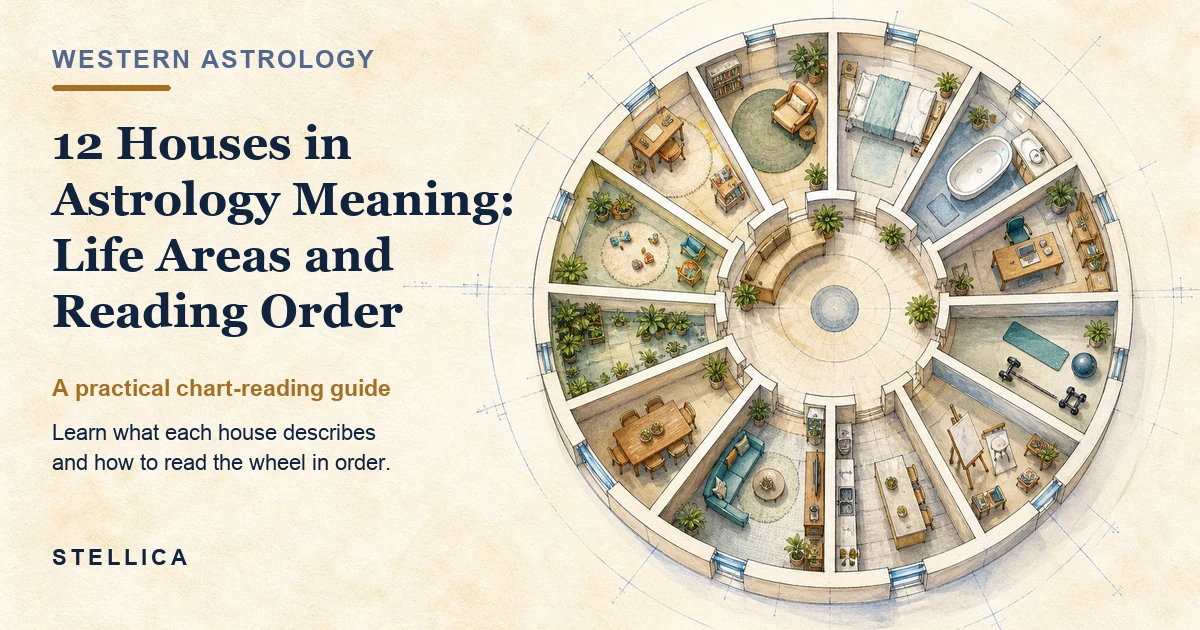
The Ascendant is the zodiac degree crossing the eastern horizon. The Midheaven, or MC, is tied to the local meridian. House systems use these time-and-place-dependent angles to divide the chart. Without a reliable moment, software can draw an Ascendant, MC, and houses only by using an assumed input. Those precise lines describe the assumption, not a recovered historical sky.
A difference of hours can move the angles and house cusps substantially. A smaller difference may matter near a boundary. Planetary house placements can change because the cusps move around them, even when the planets' zodiac signs stay the same. This is why a birthplace by itself cannot establish a Rising sign or house story.
Check the Full Local-Day Window
When no time is known, define the local birth date from its beginning to its end at the birthplace. Calculate representative points across that span, including the boundaries. The purpose is not to pick the version that feels familiar. It is to see which signs, degrees, and relationships remain invariant and where a change occurs. If a field changes, record the alternatives and the interval in which the change happens.
For the Moon, compare more than a noon snapshot. Check the start and end of the local day, then add intermediate calculations when a sign boundary or close aspect falls inside the interval. State “Moon sign remains the same across the tested day” only after that test. Avoid turning a stable sign into an exact degree claim.
Use an Approximate Window as a Range
A remembered range can reduce uncertainty when its source and wording are preserved. “Between six and eight in the morning” supports an endpoint comparison; it does not support 7:00 as an invented midpoint. “Before sunrise” may need a broader range tied to place and date. Compare the earliest and latest plausible moments, then keep only fields that survive both ends.
Narrower evidence may rule out some Ascendants or house arrangements, but any remaining option stays conditional. Document whether the range came from a contemporaneous record, a later family memory, or inference. Source quality and range width are separate questions, and both belong beside the result.
House uncertainty is not limited to the first house. Because all cusps are part of one timed framework, every planet-in-house statement inherits the missing-time problem. A planet's zodiac longitude may be well supported while its house placement changes repeatedly across the day. Keep those two coordinate systems separate in notes and prose.
The discipline applies to angle aspects. A planet conjunct the displayed Ascendant in a noon chart is an aspect to the noon placeholder's angle, not evidence of a natal Ascendant conjunction. Remove it from the stable layer. Reintroduce angle relationships only after reliable time evidence makes the underlying angle available.
Window testing does not identify the unknown instant; it identifies which claims survive uncertainty. That distinction is the safeguard.
What a Noon Chart Means—and Does Not Mean
Some calculators require a clock value even when the user does not know one. Twelve noon is a practical convention for supplying that input near the middle of the local date. It avoids silently choosing the first minute of the day, but it has no special access to the historical birth moment.
A noon chart answers one narrow question: what positions does the calculation produce at 12:00 local time under the selected place and date? It does not answer when the birth occurred. Noon is not an average birth time, a likely time, a recovered time, or evidence that an angle or house was correct. Moving the marker to noon organizes a calculation; it does not narrow the uncertainty window.
Use the noon output as one comparison point. Keep date-stable signs or relationships only after checking the wider window. Treat Moon details as conditional until the whole day or supported range has been compared. Ignore the displayed Ascendant, MC, houses, and angle-dependent claims unless independent time evidence supports that exact calculation.
| Noon can | Noon cannot |
|---|---|
| Supply one explicit time input for software | Recover or estimate the actual birth time |
| Provide a middle comparison point within the date | Verify the Rising sign, MC, or houses |
| Support a broader window test when compared with other times | Settle a Moon boundary or tight aspect by itself |
Stellica's current unknown-time path may use noon to complete the Western astrology calculation. The resulting preview remains a no-time working view. A precise degree produced through that path is precision under the placeholder, not proof that the placeholder matched the birth.
Language matters here. Write “calculated at noon because the time is unknown,” not “born at noon.” Write “this placement stayed consistent in the tested window,” not “this chart is accurate.” These phrases preserve the difference between a transparent convention and documentary evidence.
If a recorded time is later found, discard the placeholder as a birth-time claim and recalculate from the record. Compare the new chart with the earlier invariant list rather than trying to preserve every noon-based interpretation.
A middle-of-day convention can be useful operationally because every comparison uses an explicit input rather than a hidden default. Its value is transparency, not probability. Another system could use a different placeholder and remain equally unresolved, provided the placeholder and all resulting limits are disclosed.
The full-day endpoints remain necessary because changes can occur. If the Moon changes sign before noon, the noon result hides the earlier option; if it changes after noon, it hides the later option. One center point cannot represent both sides of an interval.
A Safe Unknown-Time Workflow
Treat the chart as a versioned set of claims rather than one finished picture. Each step below records the evidence, tests the supported interval, and separates invariant placements from variables. The workflow works whether nothing is known beyond the date or a rough family estimate supplies a limited range.
1. Record Known Inputs and Their Sources
Write down the calendar date, birthplace, and the exact wording attached to any time information. Preserve “hospital record: 06:42,” “family memory: early morning,” and “unknown” as different evidence states. Do not convert a phrase into a minute before testing it. Also note who supplied the information, when it was recorded or remembered, and whether the place name refers to the birth location or a later residence.
Keep the original source beside every later calculation. This prevents a provisional estimate from becoming an apparently documented fact through repetition. If sources conflict, retain both and describe the conflict. A neat single value is less useful than an honest record of what is known and why.
2. Compare the Supported Time Window
With no time, compare the beginning and end of the local date and add intermediate times where a change may occur. With an approximate range, compare its earliest and latest supported moments. Track sign changes, degree movement, Moon relationships, and aspects near the selected orb threshold. Do not choose a midpoint merely because one input is easier to read.
Build a small comparison log with the tested time, the fields that stayed the same, and the fields that changed. The log should make it possible to repeat the calculation under the same time-zone and orb conventions. If historical clock rules are uncertain, label that conversion question instead of hiding it inside the chart.
3. Keep Invariants and Bracket Variables
Move a placement into the working interpretation only when it survives the supported interval at the level you intend to discuss. A stable sign does not automatically make its degree stable. A broad aspect can remain present while a tight-orb description changes. For the Moon, list both sign possibilities if a boundary falls within the window and avoid choosing one through personal resonance.
Leave Ascendant, MC, houses, and planet-in-house interpretations blank when no reliable time exists. Blank is a meaningful result: it shows that the calculation cannot answer the question from current evidence. Maintain a separate conditional list for items that could be revisited if the range narrows.
4. Search for Documentary Evidence
Before treating the partial chart as final, look for records created close to the birth. Possible sources include a long-form civil certificate where time is recorded, hospital or midwife records where access and retention permit, a baby book, diary, family announcement, dated message, or community record. Availability varies by place, institution, year, and local rules, so no single source can be promised.
Ask relatives for the story and the source separately. “I remember seeing 6:42 on a card” is different from “I think it was around breakfast.” A memory can guide a search or define a broad range, but it should not be promoted to minute-level documentary evidence. Photograph or transcribe any record carefully, including labels that identify whose record it is.

</figure>
When a time is found, verify that the date, place, person, and time notation belong together. Check whether the document uses a twelve-hour or twenty-four-hour clock and whether an indicator such as morning or evening is present. Recalculate from the record rather than editing a noon chart by hand. Retain the earlier comparison log so you can see which observations were genuinely date-stable.
5. Use Rectification Only as a Bounded Hypothesis
Birth-time rectification is an optional astrological method that compares candidate times with dated biographical events and selected interpretive rules. It may narrow a working range within that method, but it cannot guarantee recovery of an unrecorded historical fact. Results can vary with the practitioner, event list, house system, planetary techniques, and starting range.
Label a rectified time as an estimate unless independent documentation confirms it. Record the proposed range, method, events, and uncertainty rather than reporting one minute without context. Do not use a rectified result to overwrite a contradictory contemporaneous record without investigating the discrepancy.
A receipt supports recalculation by showing which conclusions survived the window test and which require a recorded time.
A saved range comparison is more useful than one neat-looking noon interpretation because it shows which claims survive every supported time.
While records are still being sought, date-only symbolic methods may offer a separate reflective activity. Calculate Life Path Number and Master Numbers explains one numerology convention, while Kabbalah Numerology by Birth Date describes a different system. Neither method reconstructs missing Western-chart angles or substitutes for a birth-time record during the ongoing documentary evidence search.
Use the decision path below after the evidence search. Its branches assign a chart treatment; they do not manufacture a time.
Repeat this workflow whenever the evidence or range changes.
Interpretation and Stellica Product Boundaries
Calculation and interpretation are separate layers. A calculator can reproducibly place planets for a stated date, place, time, time-zone rule, and astronomical method. Astrology then assigns symbolic meaning to those positions. Technical precision in the first layer does not establish scientific validation, fixed personality, causal force, or predictive certainty in the second.
Unknown time limits both layers. The calculation cannot establish the historical horizon without the clock reading, and interpretation should not fill the missing fields through confidence or intuition. Use date-stable placements as reflective prompts. Present conditional Moon or aspect material as alternatives. Exclude Ascendant, Midheaven, houses, and angle-dependent stories when the input does not support them.
Stellica's current Western astrology form includes an unknown-time path and may calculate a noon-based working preview. The safe promise is limited to that current no-time preview. It is not a birth-time recovery service, rectification service, custom uncertainty report, complete timed chart, verified Rising sign, MC, or house analysis. The page should never imply that selecting “I don't know” turns noon into the user's time.
The Sun/Moon distinction also needs a clear owner. The Sun often remains in one sign through a date, but boundary dates still require checking. The Moon moves faster and needs a full-day or supported-window comparison. The planned guide Sun Sign vs Moon Sign is Coming soon; until then, preserve the window logic here rather than making a generalized Moon promise for every date.
Use ordinary evidence for consequential decisions. A reflective chart should not replace medical, legal, financial, safety, relationship, or employment judgment. Record access also varies, so suggestions to search a certificate, hospital archive, or community record are possibilities rather than legal or practical guarantees.
When better evidence arrives, version the result. Recalculate the entire chart, review the Moon and aspects again, and add timed fields only from the supported input. Explain what changed and what remained invariant instead of treating the earlier preview as wrong in every respect.
This boundary also protects readers from fear-based or flattering certainty. Missing data alone should not be filled with dramatic claims, and stable placements should not be promoted into diagnoses, forecasts, or guarantees.
Frequently Asked Questions
Can a birth chart be accurate without a birth time?
It can be accurate only at the level supported by the tested date or range. Some planetary signs may remain unchanged, and some slower-planet relationships may persist. Ascendant, MC, houses, and angle-dependent interpretations are not established. Describe the result as a partial chart, not a complete timed chart.
Can I know my Moon sign without a birth time?
Sometimes, but check the entire local-day or supported time window. If the Moon stays in one sign throughout that interval, the sign may be treated as stable for the tested window while its degree still changes. If it crosses a boundary, keep both signs open until stronger time evidence appears.
Why are the Ascendant, MC, and houses unavailable?
They depend on how the zodiac meets the local horizon and meridian at a specific place and moment. Earth rotates continuously, moving those angles and the house cusps. A calculator can display them under an assumed time, but the date and birthplace alone cannot verify that assumed orientation.
Is noon an estimate of my real birth time?
No. Noon is a calculation convention used when software needs a clock input. It is not an average of actual births, a likely time, a recovered time, or a hidden estimate. Use it as one comparison point and disregard its time-sensitive fields unless independent evidence supports them.
Does an approximate time window help?
Yes, if it remains a range. Compare the earliest and latest supported moments and keep only the fields that survive both endpoints. Record whether the range came from a document or a later memory. Do not replace “between six and eight” with an unsupported exact midpoint.
Where can I look for a recorded birth time?
Possible sources include a civil certificate that records time, hospital or midwife files where available, a baby book, diary, announcement, dated family message, or community record. Access and retention vary by jurisdiction, institution, and year. Verify that the document belongs to the correct person, date, and place.
Can rectification guarantee the correct time?
No. Rectification can produce a reasoned estimate within a particular astrological method by comparing candidate charts with selected events. It cannot guarantee recovery of an unrecorded historical fact. Keep the proposed time labeled as an estimate and preserve the method, range, and uncertainty unless documentary evidence confirms it.
When a new birth-time record appears, create a provenance note before recalculating. Identify where it was found, who holds it, when it was created, and whether you inspected an original, an image or copy, a later transcription, or a family note. Capture the recorded date, birthplace, clock notation, morning or evening marker, and the time-zone context used for conversion. Preserve a legible image or exact transcription when permitted, without claiming that any particular archive must provide access. If two records conflict, log both, compare their dates and chains of custody, and investigate the discrepancy; do not select the time that produces the preferred chart. Then retain the previous unknown-time receipt, rerun the Ascendant, MC, houses, Moon window, and affected aspects, and document what changed clearly.
Summary
A safe unknown-time chart keeps evidence and uncertainty visible. Test the supported window, separate stable placements from variables, and recalculate when a reliable record changes the input.
- An unknown-time chart is partial and must preserve uncertainty.
- Date-stable placements require a full-window check; precise-looking output is not evidence.
- Ascendant, Midheaven, houses, and angle-dependent claims need a reliable time.
- Noon is only a calculation convention; records and supported ranges remain the evidence path.
Make no claim more precise than its input. Preserve the source, tested interval, convention, and open alternatives so a later record can revise the chart without rewriting uncertainty as fact.