What Does Calculating a Life Path Number with Master Numbers Mean?
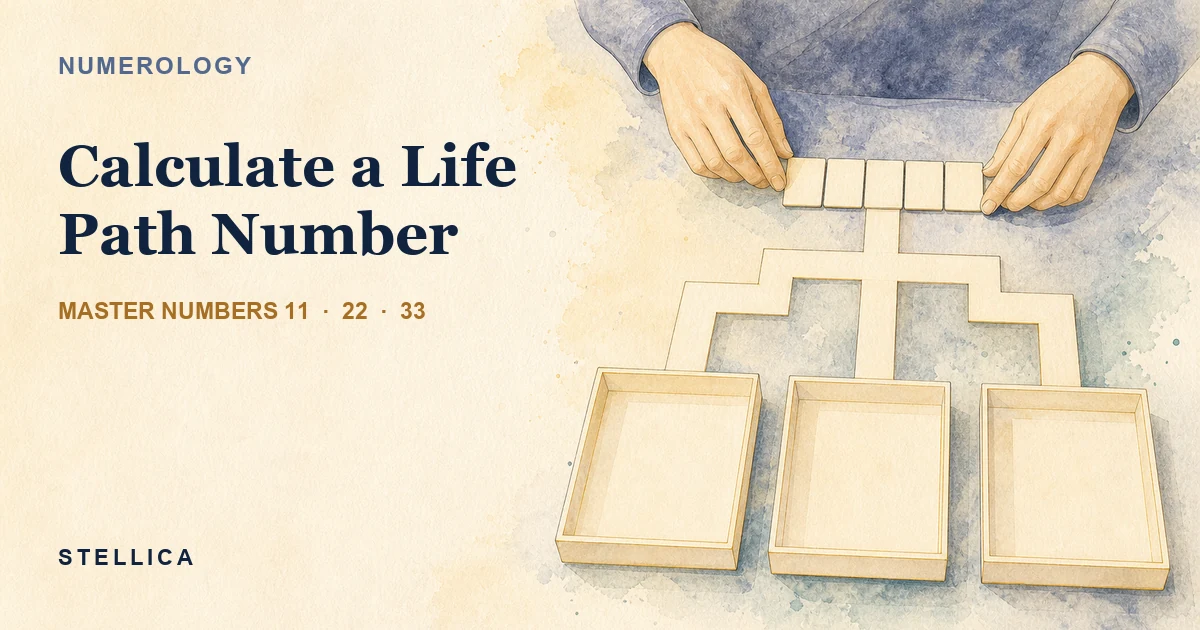
Under Stellica’s documented convention, calculate a Life Path number by writing the full date as YYYY-MM-DD, adding every digit, and reducing the running total. Stop at 1–9, 11, 22, or 33. Keep the arithmetic trail because other numerology schools may group date parts or preserve Master Numbers differently.
A Life Path calculation has two separate layers. The first is arithmetic: a disclosed date format, addition rule, and stopping rule should produce the same trail when anyone repeats it. The second is symbolic interpretation, which belongs to numerology practice rather than mathematics. A repeatable sum does not prove that a meaning is scientifically valid or universally shared.
Zero-padded months and days keep the input unambiguous, while zeros still contribute nothing to the sum.

Open the current Stellica Life Path preview if you want to compare its displayed number with your working. The preview calculates a Life Path result from a birth date; it does not promise a full numerology profile, a universal method, or guaranteed traits.
Stellica’s All-Digits Method, Step by Step
Use one sequence from input to result:
- Write the complete date in zero-padded YYYY-MM-DD form.
- Add every year, month, and day digit, including each visible zero.
- Check the current total before doing anything else.
- Stop if that total is 1–9, 11, 22, or 33.
- Otherwise, add the digits of the current total and check again.
- Repeat the reduce-and-check loop until a stopping value appears.
Ordinary example: 1990-12-15 becomes 1
Start with 1 + 9 + 9 + 0 + 1 + 2 + 1 + 5 = 28. The current total, 28, is above 9 and is not 11, 22, or 33, so continue. Add 2 + 8 = 10; check again, then add 1 + 0 = 1. One is a stopping value, making the result Life Path 1 under this convention.
For an interpretation after the calculation, Life Path Number 1 Meaning (coming soon) keeps symbolic discussion separate from this method tutorial.
Genuine Master Number example: 1980-01-03 becomes 22
Add every digit once: 1 + 9 + 8 + 0 + 0 + 1 + 0 + 3 = 22. Check immediately. Because 22 is a retained value in Stellica’s convention, stop there. Continuing to 2 + 2 = 4 would replace the displayed result and would no longer follow the stated loop.
An intermediate total can also trigger the stop. If a combined sum reduces from 29 to 11, the trail is 29 → 2 + 9 = 11, then stop. Do not wait until a single digit appears before checking. Equally, never work backward from 2, 4, or 6 and relabel it as 11, 22, or 33. The compound value must actually occur in the forward arithmetic.
A second audit can confirm the loop without changing the method. Copy the zero-padded date again, total the eight digits from left to right, and compare each recorded checkpoint. If both runs match, the arithmetic is reproducible; if they do not, inspect transcription and addition before interpreting the number.
Save the zero-padded input, each sum, and the final stopping value. That audit trail is more informative than a calculator label alone.

STELLICA APP
Stellica previewExplore your Life Path preview
Try the Life Path previewWhy Life Path Calculators Disagree
Calculator disagreement usually begins with grouping, not addition. Stellica’s all-digits method combines the eight date digits before reduction. A separate-parts method reduces the year, month, and day as units, adds those three results, then reduces again. Both procedures can be internally consistent while creating different intermediate totals.
Consider 1980-01-03. Stellica adds 1 + 9 + 8 + 0 + 0 + 1 + 0 + 3 = 22 and stops. For the disclosed comparison below, the separate-parts route reduces year 1980 to 9, month 01 to 1, and day 03 to 3. It then adds 9 + 1 + 3 = 13, followed by 1 + 3 = 4. The same date therefore yields 22 or 4 under the two named procedures.
A useful comparison receipt lists four items in order: normalized date, grouping rule, retained values, and reduction trail. With those fields visible, disagreement becomes diagnosable. Without them, two identical labels may conceal different procedures, while two different labels may simply reflect different checkpoints. Recalculate each receipt on its own terms before deciding whether an input or arithmetic error occurred during the original entry.
Record the calendar convention too, so another reader can reconstruct the same normalized date before adding its digits.
Date order is a presentation issue for the all-digits sum: the same eight digits add to the same total whether a source writes month first or day first. Yet ambiguous notation can change which date a person enters. Converting the input to YYYY-MM-DD before calculating prevents that transcription problem and preserves leading zeros.
Other calculators may retain 11 and 22 but reduce 33, check Master Numbers only at the final step, or preserve them inside separate date parts. When results differ, ask what was grouped first and when the stop rule was applied. Consistency is more useful than declaring one modern convention universal.
When to Keep 11, 22, and 33
In Stellica’s convention, retain 11, 22, or 33 whenever one is the current total after an addition. The checkpoint applies to the first combined sum and every later reduction. It does not apply to numbers you can imagine behind the result, so a trail ending at 4 remains 4 unless 22 actually appeared earlier.
The reduced bases can be recorded as context without replacing the result: 11 reduces to 2, 22 to 4, and 33 to 6. This notation can support reflection on related themes, but it is not permission to promote every 2, 4, or 6 into a Master Number. Nor does “Master” describe a higher rank, stronger person, or guaranteed capability.
Detailed meanings belong after the calculation is settled. Master Number 11 Meaning is Coming soon and will own a deeper interpretation of 11 without changing the arithmetic here. Meanings associated with 22 or 33 likewise remain symbolic themes rather than promises of achievement, service, or special status.

Another numerology source may reduce all compound totals or preserve a different set. Record that convention beside its output. Do not combine its label with Stellica’s trail, invent a historical lineage for either rule, or force a Master Number because its description feels appealing.
Preserve the forward trail before attaching any optional base notation.
Common Mistakes and an Audit Checklist
Mixing methods midway
Reducing the year as a unit, then adding raw month and day digits, splices separate-parts and all-digits procedures.
Skipping a current-total check
A trail such as 29 → 11 stops at 11 here. Reducing automatically to 2 overlooks the approved checkpoint. Check after every addition, including the first combined total.
Dropping zeros from the written date
Zeros do not affect addition, but a zero-padded input shows exactly which month and day were used. Keep 1980-01-03 visible rather than an ambiguous shortened form.
Forcing a preferred Master Number
Do not reverse 4 → 22, attach 11 to every result of 2, or select the method that gives the most flattering label. Follow the declared procedure forward and accept the value it reaches.
Saving only the final label
“Life Path 4” cannot reveal whether another calculator grouped the date differently, reduced 22, or received another input. Preserve enough working for someone else to reproduce the result.
- Confirm the complete birth date and rewrite it as YYYY-MM-DD.
- Mark the method as all digits first before calculating.
- Copy every digit, including both positions in each zero-padded part.
- Write the first combined total rather than doing it only mentally.
- After every sum, test for 1–9, 11, 22, or 33.
- If no stop value appears, reduce only the current total and repeat.
- Save the entire arithmetic trail beside the final Life Path label.
The checklist functions like a checksum: it cannot validate numerology’s meanings, but it can expose a missed digit, mixed method, skipped checkpoint, or undisclosed convention.
Calculation, Meaning, and Product Boundaries
The arithmetic layer is reproducible once the birth date and convention are fixed. The interpretive layer assigns symbolic themes to the result. Keeping those layers distinct prevents a correct sum from being presented as scientific evidence for a personality claim or future event.
That distinction supports reflection without converting a symbolic label into evidence for decisions about a reader’s life.
For wider background, What Is Numerology? is Coming soon. Kabbalah Numerology by Birth Date describes a distinct date-based system; it should not be merged with this Life Path algorithm or used to validate it.
A Life Path number may serve as a prompt for journaling, vocabulary, or reflective comparison. It does not determine destiny, diagnose health, guarantee compatibility, predict financial outcomes, or establish career suitability. Consequential choices still require relevant evidence and qualified advice where appropriate.
Stellica’s current numerology destination promises only a birth-date-based Life Path preview. It does not promise every school’s result, a complete profile, or certainty about anyone’s character. Showing the trail makes the product boundary inspectable as well as the arithmetic.
Frequently Asked Questions
Should 11, 22, or 33 be reduced?
Retain 11, 22, or 33 whenever one is the current total under Stellica’s rule; otherwise continue reducing.
Why do Life Path calculators disagree?
Grouping choices, retained values, and checkpoint timing can differ. Compare the normalized input and complete arithmetic trails.
Does MM/DD versus DD/MM change an all-digits result?
Reordering identical digits leaves their sum unchanged, but ambiguous notation can cause entry of a different date.
Can a Life Path number change?
The same date and convention reproduce one result; corrections or another method may produce a different label.
Is Life Path the same as Destiny or Expression Number?
No. Life Path uses the birth date here; Destiny or Expression calculations commonly use a person’s name.
Which intermediate totals should be preserved?
Write totals; stop when the current value is 1–9, 11, 22, or 33 under this convention.
Summary
Keep the method label beside the result so the arithmetic remains reproducible and the symbolic layer remains bounded.
- Stellica adds all YYYY-MM-DD digits and checks every current total.
- Stop at 1–9, 11, 22, or 33 under the stated convention.
- Grouping and stop-rule differences explain many calculator disagreements.
- Arithmetic can be audited; symbolic meaning remains a separate reflective layer.