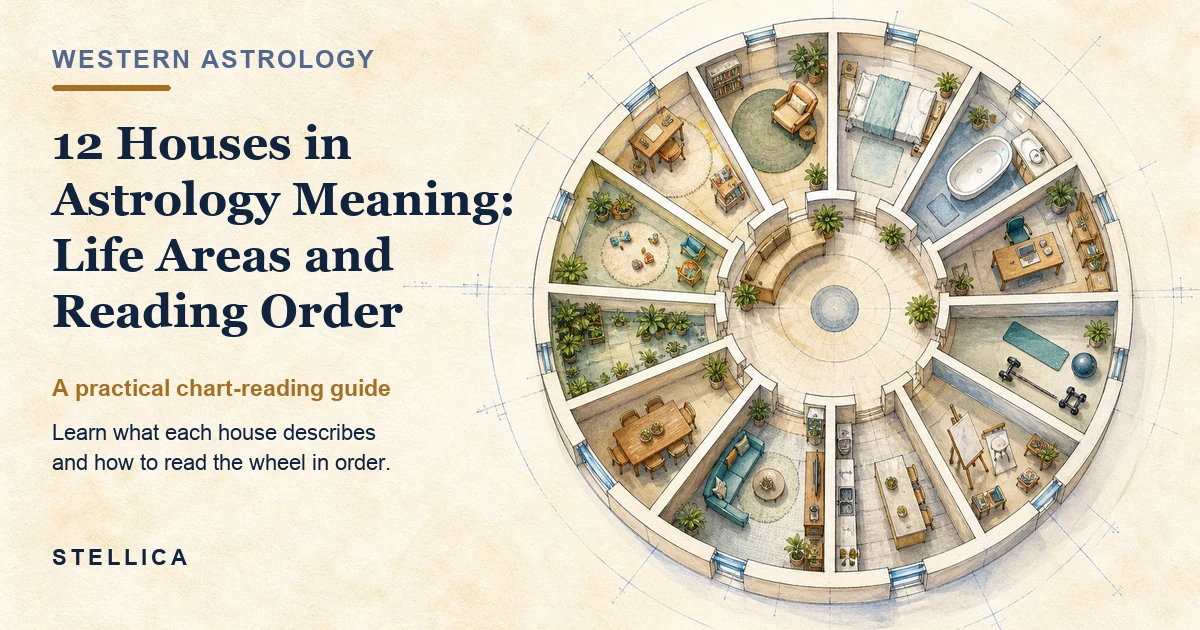
Astrology’s twelve houses are chart sectors used to organize life areas, from identity and resources to relationships, career, community, and retreat. A planet describes what function is active, a sign describes how it operates, and a house describes where it may show up. Houses frame interpretation; they do not predict events.
People searching for “12 houses in astrology meaning” usually need two things: a life-area map and a reading order. This guide provides both while keeping method and uncertainty visible.
If you want a chart reference while reading, open Stellica’s current Western astrology entry preview. It is an entry point for exploring chart structure, not a promise of an exact house grid, birth-time rectification, predictive timing, or a complete English report.
12 Houses in Astrology Meaning: The Core Idea
The 12 houses in astrology mean twelve broad categories of lived experience. They let a reader ask a location question: in which area of life might a planet’s symbolic function be explored? The first house concerns embodiment and arrival; the second concerns personal resources and value; the sequence continues through communication, home, creativity, maintenance, partnership, shared matters, wider learning, public contribution, community, and retreat.
That list is a map, not a set of sealed rooms. A conversation with a partner could involve the third house because words are exchanged, the seventh because two people are negotiating, and the eighth because they are deciding how to share resources. A house helps establish the main category in a chart technique. It does not prevent real experiences from crossing categories.
Houses Are Not Zodiac Signs
A house and a zodiac sign answer different questions. A sign is a twelve-part division of the zodiac and supplies a style or mode in interpretation. A house is a division anchored to the local horizon and meridian, or derived from those anchors according to a chosen house system. The two sets both contain twelve parts, but they are not interchangeable.
You may see a teaching sequence that pairs the first house with Aries, the second with Taurus, and so on. That “twelve-letter alphabet” can be a memory aid in some modern astrology, but it should not erase historical and technical differences. A first house can begin in any rising sign. Its topics do not become Aries topics simply because both appear first in their respective sequences.
That distinction also prevents a common reading shortcut. Suppose Venus is in Capricorn in the fifth house. Venus names a symbolic function involving attraction, preference, connection, or aesthetics. Capricorn describes a measured, sustained, or structured style. The fifth house locates the inquiry in creativity, play, pleasure, or courtship. Replacing “fifth house” with “Leo” would add a sign that is not actually in the placement.
Houses Depend on the Local Sky
House calculation ordinarily uses date, exact time, and place of birth because the horizon changes through the day and by location. The Ascendant marks the eastern intersection used to orient the chart. Different mathematical systems then divide or assign the remaining sectors in different ways. If the recorded time is wrong or missing, the Ascendant and house placements may be unreliable even when many planets remain in the same zodiac signs.
This is an input boundary, not a reason to invent a time that “fits.” If your time is uncertain, keep houses out of the confident part of the interpretation. A birth chart without an exact birth time can still support sign-based and many aspect-based observations while clearly labeling what cannot be established.
The personal/interpersonal split is another learning aid, not a personality score. Having more planets below or above the horizon does not prove that someone is inward, outward, selfish, or social. It simply gives a reader a pattern to investigate alongside the actual planets, signs, angles, aspects, chart method, and lived experience.
STELLICA APP
Stellica previewExplore Stellica’s English diagnosis previews
Explore English previewsThe 12 Houses and Their Life Areas
Each description below begins with a category, then shows how to keep interpretation provisional. The examples are deliberately modest. “May emphasize” or “can be explored through” marks a symbolic reading, not a statement about what a person is, what will happen, or which life area matters most.
1st House — Self, Body, and Arrival
The first house begins at the Ascendant in many commonly used chart formats. It organizes questions about embodiment, appearance, immediate approach, and how a person enters a situation. It is less a complete personality portrait than the point where the chart meets the local eastern horizon. A planet here is often treated as especially visible because it is close to an angular point.
Mars in the first house, for example, might prompt questions about direct action, speed, assertion, or how energy is carried physically. It does not prove athletic ability, aggression, leadership, or a particular body type. The sign describes the style available to Mars, aspects show relationships with other chart functions, and ordinary evidence determines whether the prompt is useful.
Use the first house to ask: What do I tend to do at the threshold of a new situation? What part of my approach is immediately noticeable, and what part changes with context? Those questions produce observations. They avoid turning appearance or first impressions into a permanent verdict.
2nd House — Personal Resources and Values
The second house gathers what a person can call their own: money, possessions, material supports, skills that can be developed, and standards of value. “Value” can mean financial valuation, but it can also mean what is worth time, care, or effort. This is not a wealth score. No planet in the second house guarantees income, loss, talent, or self-worth.
Venus in the second house might lead a reader to examine how preference, attraction, agreement, or aesthetics participate in resource choices. In one life that could appear as careful collecting; in another, as pricing creative work; in another, as negotiating purchases with a partner. The placement opens a category. It does not choose the outcome.
Compare the second house with the eighth. The second starts from personal control and personal standards; the eighth asks what happens when resources, obligations, or vulnerabilities are shared. The contrast is useful even when one real decision activates both.
3rd House — Communication, Learning, and the Local World
The third house concerns everyday exchange: speech, writing, listening, early or practical learning, siblings in many traditions, neighbors, short journeys, and the information routes that connect ordinary life. It is not an intelligence score. It asks how information is gathered, moved, repeated, translated, or discussed within reachable networks.
Mercury in the third house is an easy example because Mercury already symbolizes language, mediation, and thinking in many Western approaches. The overlap may make those topics noticeable, but it does not automatically mean “good communicator.” Mercury’s sign, aspects, condition, and the person’s circumstances change how the symbolism may be used. Silence, editing, technical notation, multilingual work, or careful listening could be just as relevant as rapid speech.
A useful third-house question is: Which channels make an idea easier to understand? Another is: What assumptions do I inherit from my immediate environment, and how do I check them? Those questions keep the category practical and allow different styles of communication to count.
4th House — Home, Roots, and Private Foundations
The fourth house is anchored by the IC in quadrant systems and occupies the base of many chart drawings. It organizes home, family history, ancestry, land or dwelling, privacy, and the conditions that create an inner base. Different traditions assign parents or lineage figures differently, so “the mother” or “the father” should not be presented as a universal fourth-house rule. “Caregivers, family structures, and inherited patterns” leaves room for actual lives.
The Moon in the fourth house might prompt attention to changing needs for privacy, familiarity, care, or belonging. It does not prove a happy childhood, a close family, a future move, or emotional dependence. A reader can ask which environments support recovery and which inherited habits still shape the present. The answer belongs to experience, not to the chart alone.
The fourth and tenth houses form a private/public axis. The fourth asks about the base from which life is lived; the tenth asks about visible contribution and accountability. Working from home, caring for family while holding a public role, or managing property can activate both. The axis describes a comparison, not a command to divide life evenly.
5th House — Creation, Pleasure, and Play
The fifth house collects voluntary expression: making, performing, play, hobbies, pleasure, courtship, children in many traditional lists, and the willingness to bring something personally meaningful into view. It is not a promise of artistic talent, romance, fertility, fame, or a career in entertainment. Those are different claims requiring ordinary evidence and, for health or fertility, appropriate professional knowledge.
The Sun in the fifth house may direct attention toward authorship, visibility, delight, or the experience of investing identity in a creation. For one person the arena could be music; for another, coaching a team; for another, designing games with friends. The example stays useful when it describes a place to investigate rather than declaring that someone “must be a creator.”
The fifth follows the fourth in the sequence: after a base is established, something can be expressed from it. It also opposes the eleventh. The fifth highlights personal contribution and immediate enjoyment; the eleventh asks how individual contribution participates in a group or future aim. A community project can contain both.
6th House — Routine, Service, and Maintenance
The sixth house concerns the repeated work that keeps life functioning: routines, tasks, craft, service, coworkers in some approaches, care responsibilities, tools, and maintenance of the body and environment. Traditional sources also connect it with illness and difficulty. A modern article must keep a firm boundary here: a sixth-house placement cannot diagnose a condition, identify its cause, or replace medical assessment.
Saturn in the sixth house might prompt questions about scheduling, standards, limits, apprenticeship, or how responsibilities accumulate. It does not prove poor health, overwork, discipline, or career hardship. A practical reading could compare which routines are sustainable, which rules were inherited, and where a task needs clearer limits or support.
The sixth and twelfth houses both deal with what can disappear from public view. The sixth emphasizes repeated maintenance and concrete obligations; the twelfth emphasizes retreat, closure, seclusion, and what happens behind the scenes. Rest can support maintenance, and maintenance can protect rest. Neither house should be treated as a punishment category.
7th House — Partnership, Contracts, and One-to-One Encounters
The seventh house begins at the Descendant in many common chart formats. It organizes committed partnership, contracts, negotiation, consultation, and open one-to-one encounters. Some traditional lists include marriage and opponents. The category is wider than romance: a client, collaborator, mediator, competitor, or person across a negotiating table can all fit the seventh-house frame.
Venus in the seventh house may invite questions about agreement, preference, reciprocity, aesthetics, or the wish to maintain connection in one-to-one settings. It does not guarantee marriage, popularity, harmony, or an “ideal partner.” A useful reading notices both the function and the terms of the relationship: What is being exchanged? Who can consent, revise, or leave? Which expectations are explicit?
The first/seventh axis helps separate self-definition from encounter. It does not say that identity must be completed by another person. Partnership can reflect a theme, challenge a habit, or offer a setting for practice without becoming a fixed destiny.
8th House — Shared Resources, Trust, and Transition
The eighth house gathers matters that cannot be managed as purely personal property: joint finances, debt, tax, inheritance, support, obligations, trust, disclosure, and transitions that alter control. Many modern astrologers add psychological depth, intimacy, or transformation; traditional authors may emphasize mortality, fear, and other people’s assets. Because those meanings vary, identify which one a reading uses instead of blending them into a dramatic prediction.
Mercury in the eighth house might direct attention to conversations, records, questions, or negotiations involving shared obligations. It does not predict inheritance, debt, secrecy, trauma, or a particular kind of intimacy. A grounded prompt would ask how complex information is disclosed, who has access, and what agreement makes sharing safer or clearer.
The eighth house is often sensationalized. A planet there is not evidence of danger, death, psychic power, or inevitable crisis. The useful category is interdependence: what changes when a resource, responsibility, risk, or confidence is held with someone else?
9th House — Wider Learning, Belief, and Long Journeys
The ninth house concerns frameworks that enlarge the local picture: advanced study, philosophy, religion, law in traditional lists, publishing, teaching, cultural exchange, and long-distance travel. The third house gathers and circulates nearby information; the ninth asks how facts become a worldview. Neither house owns intelligence, truth, or moral authority.
Jupiter in the ninth house may encourage questions about expansion through study, teaching, travel, or a broad interpretive system. It does not guarantee higher education, international travel, wisdom, good fortune, or a correct belief. Jupiter’s sign and aspects modify the prompt, and access, resources, institutions, and personal choices shape what is possible.
A careful ninth-house reading includes intellectual humility. Ask which sources support a belief, whose experience is missing, and what evidence could revise the framework. Astrology itself is one interpretive tradition among many; using its categories does not make its claims scientific proof.

10th House — Public Role, Vocation, and Accountability
The tenth house is associated with the Midheaven in many quadrant systems, although the MC can fall in another house in some methods. It organizes visible contribution, vocation, reputation, authority, responsibility, and the roles by which work is recognized publicly. Career is a common topic, but the tenth is not a job-title generator or a success score.
Saturn in the tenth house might prompt questions about long time horizons, rules, standards, accountability, or relationships with institutions and authority. It does not prove ambition, delay, hardship, status, or eventual achievement. One person may experience the symbolism through professional licensing; another through community responsibility; another through learning when to decline a public role.
The tenth asks what can be seen and evaluated by a wider world. That differs from the sixth house’s focus on repeated tasks and maintenance. A prestigious title without workable routines can expose the difference; so can skilled daily labor that is not publicly visible. A complete work discussion may need both categories.
11th House — Friends, Groups, and Future Aims
The eleventh house concerns allies, friends, groups, associations, audiences, collective projects, and hopes oriented toward a future larger than one person. It can describe how an individual participates in networks, but it does not count friends, promise popularity, prove humanitarian values, or guarantee that a goal will be achieved.
Uranus in the eleventh house, in a modern approach, might invite inquiry into experimentation, discontinuity, independence, or technical change within groups. A traditional approach would not use Uranus and might follow the ruler of the eleventh instead. Naming the method prevents a modern interpretation from being presented as timeless consensus.
An eleventh-house question might be: Which groups make room for both contribution and dissent? Another is: What future aim becomes possible only through coordination? These prompts keep “community” concrete enough to test while avoiding the claim that every network is supportive.
12th House — Retreat, Closure, and What Happens Behind the Scenes
The twelfth house has one of the widest and most difficult histories. Traditional lists include confinement, hidden opposition, loss, and institutions; modern psychological astrology often adds the unconscious, spirituality, dreams, retreat, self-undoing, or compassion. This article uses a restrained common center: seclusion, closure, withdrawal, hidden labor, and experiences outside ordinary visibility.
The Moon in the twelfth house might prompt questions about privacy, rest, unspoken feeling, care performed out of view, or how solitude affects emotional processing. It does not diagnose mental illness, prove psychic ability, reveal secret enemies, or mean someone is self-destructive. Those claims can cause harm when a broad symbol is treated as evidence.
The twelfth completes the cycle before the first house begins again. Closure may be chosen or imposed; solitude may restore or isolate; behind-the-scenes work may protect or erase contribution. The chart cannot decide which is occurring. A reader needs context, consent, and real observation.
How to Combine a Planet, Sign, and House
The most reliable beginner method is to separate the layers before writing a sentence. Start with what the chart or software actually calculated. Name the planet, its zodiac sign, and its house. Then assign each layer one limited job: planet as symbolic function, sign as operating style, and house as life-area context. Only after that should you write an interpretation—and that interpretation should remain open to observation.
This order prevents a vivid house keyword from swallowing the rest of the placement. “Mars in the seventh means conflict in marriage” jumps from one symbol to one event, assumes romance, and treats possibility as prediction. A layered reading sounds more like this: “Mars brings action, assertion, or friction; Virgo gives that function an analytical and corrective style; the seventh places the inquiry in one-to-one agreements. I might examine how critique, initiative, and boundary-setting work in close negotiations.”
That sentence is longer, but each claim can be inspected. “Mars is in Virgo in the seventh house” is a calculated placement, assuming reliable data and a declared system. “Analytical assertion in agreements” is a symbolic synthesis. “I tend to edit shared plans before anyone asks” would be a lived observation. Keeping those levels separate is the difference between using astrology as a prompt and claiming that astrology proves behavior.
Step 1: Choose a Manageable Planet Vocabulary
Begin with two to four neutral verbs or functions rather than a personality label. The Sun can involve centering, authorship, visibility, or the organization of identity. The Moon can involve response, familiarity, care, rhythm, or changing needs. Mercury can involve naming, connecting, comparing, recording, or translating. Venus can involve valuing, attracting, relating, harmonizing, or choosing. Mars can involve initiating, separating, defending, competing, or applying force.
The slower planets also need a declared approach. Jupiter may expand, connect to a framework, authorize, or seek meaning. Saturn may define, limit, stabilize, delay, or make accountable. Uranus, Neptune, and Pluto belong primarily to modern astrological practice; traditional readers use different toolsets. Using one school consistently is clearer than collecting every keyword and pretending they are universal.
Sun Sign vs. Moon Sign is planned and coming soon; it will compare two planetary functions without treating either one as a complete personality.
Step 2: Describe the Sign as a Style, Not a Character Verdict
Signs modify how a planetary function is imagined to operate. Instead of “Gemini is unreliable,” try “Gemini may distribute attention across connections, questions, or multiple channels.” Instead of “Capricorn is cold,” try “Capricorn may prioritize structure, duration, responsibility, or measurable progress.” The second phrasing supplies usable dimensions without assigning a moral quality.
Apply the style to the planet, not directly to the person. “Mercury in Capricorn may structure communication” is narrower than “you are a serious thinker.” It also leaves room for aspects, house context, education, language access, disability, profession, and choice. A placement is one symbolic component, not a diagnosis of the whole individual.
Step 3: Select the House Topic That Fits the Question
Every house carries multiple topics. If you are reading Venus in the fifth house, the relevant topic may be creative pleasure, courtship, play, performance, or work involving children. Do not force all of them into one sentence. Ask what the reader is trying to understand and choose the least dramatic category that fits.
Context also determines whether another house owns the main question. A designer’s daily production process may belong primarily to the sixth house, the finished portfolio to the fifth, pricing to the second, client negotiation to the seventh, and public reputation to the tenth. Saying “creativity is fifth house” is a starting point, not a reason to ignore the rest of the chart or the structure of actual work.
Step 4: Add Aspects and Rulers After the Basic Sentence
Aspects describe angular relationships between planets or points. They can show how the focal planet participates in other chart functions, but they should not be used to rescue an unclear basic sentence. First name planet, sign, and house. Then add one close, relevant aspect and see what new question it introduces.
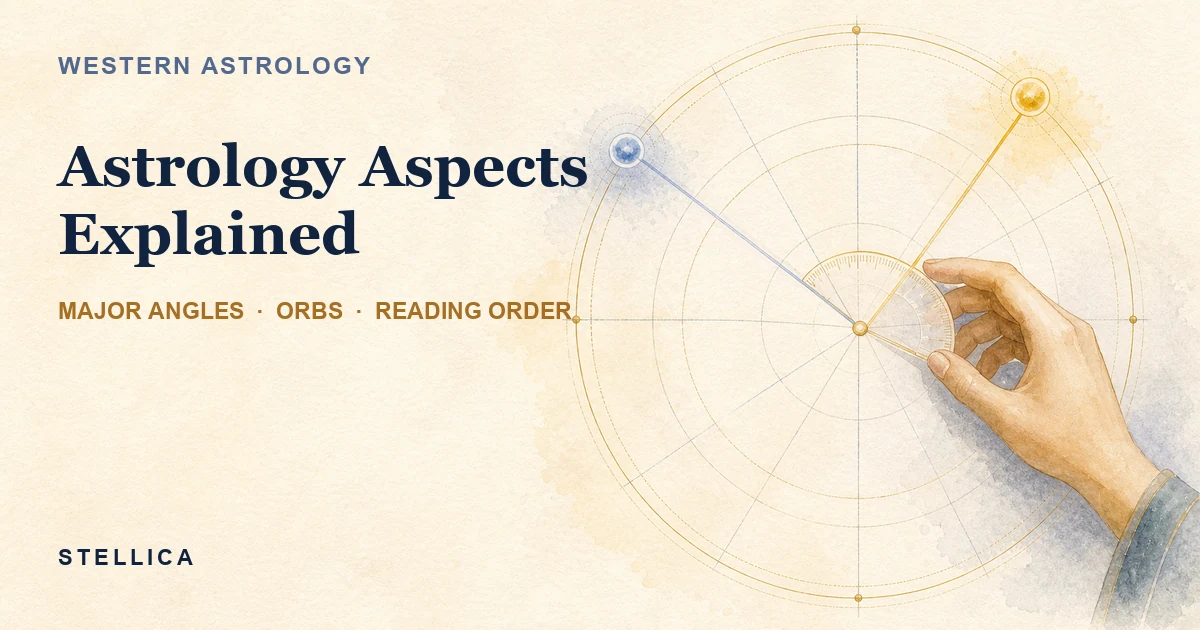
For example, Mercury in Capricorn in the eighth might suggest structured communication about shared obligations. A square from Mars could add pressure, urgency, disagreement, or the need to act. It still does not predict a financial argument. The reader can ask where urgency clarifies a joint decision and where it makes listening harder. Astrology aspects explained gives the fuller angle-and-orb reading order.
The ruler of a house is another later layer. It links the house’s topics to the planet ruling the sign on its cusp. Because rulership schemes differ between traditional and modern practice, record which scheme you use. Follow one ruler trail at a time; otherwise a beginner reading can become an endless chain of associations with no testable center.
Worked Example: The Same Planet and Sign in Two Houses
Imagine Mars in Taurus. Mars supplies action, assertion, defense, separation, or effort. Taurus can describe a steady, conserving, tactile, or persistent style. In the second house, the combined prompt might concern sustained effort around personal resources, values, or material support. In the seventh, the same planet and sign might concern steady assertion, slow conflict, or persistence within one-to-one agreements.
Nothing in those sentences proves whether the person saves money, argues with partners, works slowly, or succeeds through persistence. They identify where to look. A useful follow-up might be: “When a decision needs endurance, do I hold a clear boundary, or do I keep the same position after the situation has changed?” Real examples can then support, reject, or refine the symbolic prompt.
This comparison is why houses matter. A planet and sign can remain identical while the life-area context changes. It is also why a house should not be read as a prediction: changing the category changes the question, not the certainty.
Angles, Empty Houses, and House Rulers
Once the twelve categories are familiar, three structural details make a chart more specific: the four angles, whether planets occupy a house, and the ruler of the sign on a house cusp. These details organize attention. They do not divide the chart into important and unimportant life areas.
Start With the Four Angles
The Ascendant, IC, Descendant, and Midheaven are local-sky reference points rather than planets. The Ascendant marks the eastern horizon and commonly begins the first house. The Descendant is opposite it on the western horizon and commonly begins the seventh. The MC and IC relate to the upper and lower meridian, although their house placement depends on the system.
Planets near angles are often treated as prominent because the angles orient the chart. “Prominent” means worth reading early, not objectively stronger, better, louder in every situation, or guaranteed to create a visible event. Before interpreting an angular planet, confirm the birth time. A few minutes can matter near a house boundary, and a large time error can move the entire framework.
Empty Houses Are Still Part of the Map
Most natal charts contain houses without any of the commonly used planets. This is mathematically ordinary: twelve houses must contain a limited number of bodies, and those bodies often cluster. An empty house does not mean that career, relationship, money, family, creativity, or another area is absent. It means no selected natal planet is placed directly in that house under the chosen system.
Avoid the opposite exaggeration too. An empty house does not prove that the life area is easy, unimportant, automatic, or free of challenge. House topics arise through ordinary life, time-based techniques, aspects to the cusp or ruler in some methods, and the location and condition of the house ruler. The natal chart does not contain a switch that turns a life area off.
To read an empty house, first note the sign on its cusp or the sign assigned to it in Whole Sign houses. Then identify that sign’s planetary ruler according to the rulership scheme you are using. Find the ruler’s sign, house, and close aspects. The ruler’s location connects the empty house’s topics to another part of the chart without filling the house with an invented planet.
Suppose the seventh house is empty, Gemini is on its cusp, and Mercury is in Capricorn in the second house. A restrained synthesis might be: “One-to-one agreements may connect with careful communication about values, resources, or ownership.” It should not become “you will marry for money” or “your partner will be a Capricorn.” The ruler trail relocates a question; it does not identify a future person or motive.
A Stellium Shows Concentration, Not Destiny
A stellium generally means several planets gathered in one sign or house, but definitions differ. Some astrologers require three planets; others prefer four or specify which bodies count. State the rule before using the label. Then read the planets and their relationships rather than assuming the house keyword explains them all.
A tenth-house stellium may concentrate several symbolic functions in public-role or accountability topics. That does not guarantee a high-status career, visibility, ambition, or occupational success. The planets may cooperate, compete, or describe different parts of a public situation. Timing, access, discrimination, economics, care duties, skills, and choice remain part of the real-world picture.
Use concentration as a reading priority: there is more symbolic material to organize in that category. Do not use it as a ranking that makes every empty or lightly occupied house irrelevant.
Why House Systems Can Change a Placement
A house system is the method used to divide or assign the chart’s twelve houses. Astrologers have developed several systems, and they do not always place a planet in the same numbered house. That disagreement is not a software error by itself. Two programs can use identical birth data and planetary positions yet display a different house placement because their house-system settings differ.
The first discipline is therefore documentation. Record the birth data source, time zone, location, zodiac type, and selected house system before comparing readings. If two charts disagree, compare settings before comparing meanings. Otherwise a technical difference can be mistaken for a mysterious contradiction about the person.
Whole Sign Houses
Whole Sign houses assign the entire rising sign to the first house, the next zodiac sign to the second, and so on. If the Ascendant is at 18 degrees of Libra, all of Libra is the first house, all of Scorpio is the second, and all of Sagittarius is the third. Every house spans one complete sign.
In this method, the Ascendant degree remains an important point within the first house rather than necessarily serving as its boundary. The MC also remains a meaningful point and may fall in the ninth, tenth, or another nearby house depending on latitude and chart geometry. A beginner should not force the MC to be the tenth-house cusp when the chosen method does not define it that way.
Whole Sign houses avoid unequal sizes and intercepted signs. They are prominent in contemporary revivals of Hellenistic astrology, but “oldest” does not mean universally correct for every reader or purpose. Use the method because its rules and tradition fit the technique being practiced, not because age guarantees truth.
Equal House
Equal House begins the first-house cusp at the exact Ascendant degree and creates twelve houses of 30 degrees each. An Ascendant at 18 degrees Libra produces a second-house cusp at 18 degrees Scorpio, a third at 18 degrees Sagittarius, and so forth. The signs and houses overlap in consistent equal arcs, but a house can contain portions of two signs.
Because the houses remain equal, the method avoids the extreme house sizes that can appear in some quadrant systems at high latitudes. It still differs from Whole Sign: the Ascendant’s sign is not automatically identical to the entire first house, and planets earlier in that rising sign can fall in the twelfth.
Placidus and Other Quadrant Systems
Placidus is a widely used quadrant system in modern Western astrology. It divides the arcs between the Ascendant, IC, Descendant, and MC using a time-based construction, so intermediate houses can be unequal. At some high latitudes, calculation can become extreme or unavailable. Other quadrant systems, including Regiomontanus, Campanus, and Koch, use different mathematical constructions and can produce different cusps.
“Placidus is common” and “Placidus is best” are not the same claim. Popularity depends on era, region, software defaults, and astrological school. A chart reader should name the system, apply its internal rules consistently, and avoid telling a beginner that one result is the authentic chart while every other result is wrong.
Cusps, Interceptions, and Boundary Planets
A cusp is a house boundary in cusp-based systems. Some astrologers interpret a planet within a few degrees of the next cusp as influencing both houses; others place it strictly according to longitude and the selected system. There is no single universal “five-degree rule.” If a reading uses a cusp allowance, name the allowance and test whether it adds clarity rather than hiding uncertainty.
An intercepted sign appears when a sign falls entirely inside a house without appearing on a cusp, usually alongside its opposite sign in unequal-house systems. Whole Sign and Equal House do not produce interceptions by their definitions. Interception interpretations vary widely, and some are highly deterministic. Treat “blocked,” “hidden,” or “unable to express” as school-specific metaphors, not established facts.
When a planet changes houses between systems, write two bounded readings. Keep the planet and sign constant, then compare only the house question. If Mercury moves from the third to the fourth, one version investigates everyday exchange and local learning; the other investigates home, roots, and private foundations. Look for situations where each lens helps. Do not manufacture a life event to select a winner.
A Practical System-Comparison Workflow
Use this sequence when two charts disagree:
- Confirm both charts use the same date, time, time zone, daylight-saving rule, and place.
- Confirm both use the same tropical or sidereal zodiac and the same node or point settings when relevant.
- Record each house system by name rather than accepting a hidden app default.
- Compare the Ascendant and MC degrees. If those differ, the problem is broader than house division.
- Identify only the planets that change houses; do not rewrite placements that remain stable.
- Write one neutral house question for each version and compare it with lived examples.
- Preserve the uncertainty in notes. A preference for one method is not proof that the other calculation is false.
If the birth time itself is uncertain, system comparison cannot repair the missing input. Work with stable sign and planet relationships first. Rectification—estimating a birth time from events—is a specialized interpretive procedure, not something this guide or Stellica’s current entry preview promises.
How to Use Houses Without Turning Them Into Predictions
House language becomes risky when a category is mistaken for an event. The seventh house can organize partnership topics, but it cannot prove that someone will marry. The tenth can organize public-role topics, but it cannot select a career or promise status. The sixth can organize maintenance and health-related routines, but it cannot diagnose illness. The eighth can organize shared resources and mortality symbolism, but it cannot predict death, debt, or inheritance.
The safest method is not to strip astrology of every interpretation. It is to make the level of each statement visible. A chart contains calculated facts within a declared method. An astrologer applies a symbolic tradition to those facts. A person then compares the prompt with observation, context, and other kinds of evidence. Problems arise when the middle layer is presented as if it were the first or third.
Separate Fact, Symbolic Prompt, and Observation
Consider “Saturn is in the tenth house.” If the birth data, planetary calculation, zodiac, and house system are known, that is a reproducible placement statement. “Saturn in the tenth may frame public responsibility through structure, limits, or long time horizons” is an interpretation within an astrological system. “I need clear milestones before accepting a visible role” is an observation that can be checked in real situations.
Do not reverse the sequence. A difficult experience at work does not prove a tenth-house Saturn, and a tenth-house Saturn does not prove a difficult experience at work. The symbolic link can organize reflection without functioning as a causal or scientific explanation.
Use House Questions Instead of House Verdicts
A verdict closes inquiry: “Your empty seventh house means relationships are easy.” A question opens it: “What sign is on the seventh-house cusp, where is its ruler, and what patterns do you observe in one-to-one agreements?” The second form can be revised when data, method, or experience changes.
Useful questions for any house include:
- Which concrete situations belong to this life-area category, and which belong mainly to a neighboring house?
- What does the planet actually symbolize in the tradition being used?
- How does the sign modify the function without becoming a personality label?
- Which close aspects repeat, complicate, or counter the first interpretation?
- What ordinary evidence supports the reading, and what example contradicts it?
- Would the sentence still be useful if it were framed as a choice rather than a prediction?
One counterexample is valuable. If a reader claims that Venus in the second always spends on beautiful objects, look for decisions where preference supported saving, pricing, repair, or refusing a purchase. The counterexample does not “disprove” the symbolic placement; it reveals that the first wording was too narrow.
Keep Timing Techniques Separate
Natal houses describe a birth-chart framework. Transits, annual profections, solar returns, progressions, and other timing methods add a separate layer with their own rules. A transit through the seventh house does not automatically mean a relationship begins, and a transit through the tenth does not automatically mean a promotion. At most, the method identifies a category that astrologers may watch during a period.
If timing is used, document the natal placement, the moving body or point, exact dates or orb rules, and the technique. Then describe a range of possible topics rather than one promised event. This article does not teach predictive timing, and Stellica’s current Western astrology entry should not be read as making those promises.
Build a Small Reading Receipt
Before writing a synthesis, record the evidence in a compact worksheet:
| Layer | What to record | What not to infer yet |
|---|---|---|
| Input | Date, exact time source, place, time zone | That the time is correct because the chart “fits” |
| Method | Zodiac and house system | That one system is universally best |
| Placement | Planet, sign, house, degree | A job, partner, diagnosis, or future event |
| Context | Close aspects, angle proximity, house ruler | That more symbols create more certainty |
| Interpretation | One neutral function-style-area sentence | A fixed personality or moral ranking |
| Observation | One supporting and one complicating example | That selective memory proves causation |
This receipt makes revision possible. If a corrected birth time moves a planet, you can identify which statement changes. If a house system changes, you can compare the old and new life-area questions without rewriting the planet and sign. If lived experience contradicts the sentence, you can narrow or discard the interpretation rather than treating the person as the problem.
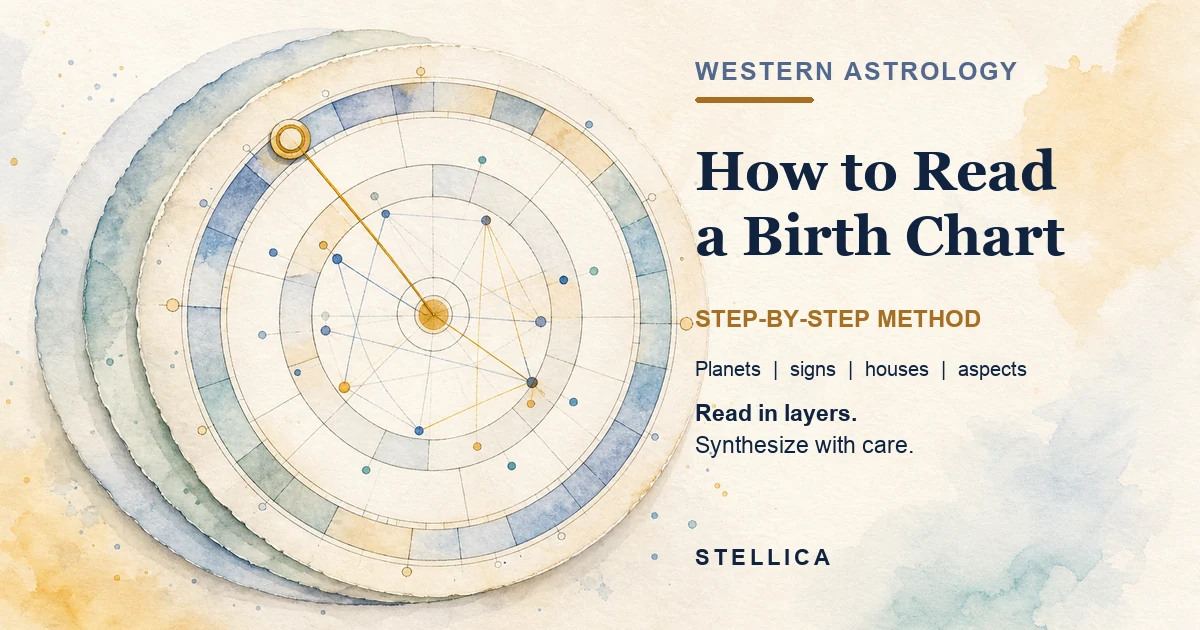
How to Read a Birth Chart is planned and coming soon; it will place houses inside a broader whole-chart sequence.
This ladder also protects disagreement. Two astrologers can calculate the same placement and choose different symbolic vocabulary. Two people can use the same vocabulary and recognize different examples. The transparent response is to show the method and evidence, not to increase certainty until the reading sounds authoritative.
Frequently Asked Questions About the 12 Houses
Do I need an exact birth time to know my houses?
Usually, yes. Houses are oriented from the local horizon and meridian or from an Ascendant derived from them. A reliable date, time, location, and time-zone conversion are needed to establish those points. If the time is approximate, a planet near a cusp may change houses; with a larger uncertainty, the Ascendant and much of the house map may change. Do not guess a time because one interpretation feels accurate.
Does an empty house mean that life area is missing?
No. It means none of the selected natal planets is located there in the chosen house system. Read the sign on the cusp or assigned to the house, then follow its ruler. Keep the result provisional. An empty tenth does not remove work or public responsibility; an empty seventh does not remove one-to-one relationships.
Which is the strongest or most important house?
There is no universally most important life area. Angular houses—first, fourth, seventh, and tenth—are often prioritized because they anchor the chart, and planets near angles are commonly treated as prominent. A stellium may concentrate attention elsewhere. “Read earlier” does not mean better, more powerful in every context, or more fated.
Are the first house and Aries the same thing?
No. Aries is a zodiac sign; the first house is a local-sky or system-derived life-area sector. Pairing Aries with the first house is a modern teaching correspondence used by some schools. A real first house can begin in any rising sign, and its topics should not be replaced with Aries keywords unless Aries is actually relevant to that chart.
What if a planet is close to a house cusp?
First record its exact degree and the selected system. Some astrologers apply a cusp allowance and read the planet in both neighboring contexts; others place it strictly in the calculated house. There is no universal allowance. Compare two bounded readings, state the convention, and preserve uncertainty instead of claiming the planet secretly belongs to whichever house sounds more accurate.
Why does one app put my planet in a different house?
Check the birth data, time zone, zodiac, and house-system settings. Whole Sign, Equal House, Placidus, and other systems use different boundaries. A planet can therefore move even when its zodiac longitude stays identical. If the Ascendant or planet degree differs too, investigate input or calculation settings before interpreting the house change.
What is an intercepted house or sign?
In unequal-house systems, an intercepted sign is contained inside a house without appearing on a cusp; the opposite sign is intercepted too. Whole Sign and Equal House do not create interceptions. Meanings such as “blocked” or “hidden” belong to particular interpretive schools and should not be treated as facts about a person’s capacity or fate.
Can houses predict marriage, career, illness, or death?
No house placement establishes a specific event. Astrology uses houses to organize symbolic topics. Marriage depends on people and consent; career depends on skills, access, economics, choices, and institutions; medical matters require qualified assessment; death cannot be responsibly predicted from a house. A house may supply a reflection question, not a guarantee.
Summary
- The twelve houses organize life-area questions; they do not function as twelve event predictions.
- Planets describe symbolic functions, signs describe styles, and houses describe where an inquiry may be located.
- Accurate house placement usually needs a reliable birth time and a declared house system.
- Empty houses remain part of the chart; follow the cusp sign and its ruler without calling the area absent.
- Keep calculated facts, symbolic interpretations, and lived observations separate so every claim can be revised.
To explore the chart framework alongside this guide, use Stellica’s current Western astrology entry preview with the same boundaries: it is a starting point for reflection, not a promise of prediction or certainty.