To read a birth chart, begin with the chart’s data and the Ascendant, then read the Sun and Moon, personal planets, houses, and only the tightest major aspects. Treat each placement as planet + sign + house, and use aspects to modify—not replace—that sentence. Exact birth time is required for reliable angles and houses.
Learning how to read a birth chart can feel like facing dozens of symbols that demand equal attention. The chart, also called a natal chart, becomes easier to read when you treat it as a layered map and decide what deserves priority before collecting meanings. The goal is not to decode every mark in one sitting. It is to build a small number of supported observations, connect them carefully, and leave uncertain details open.
If you want a chart in front of you while following the method, open Stellica’s Western astrology diagnosis. Use the most accurate birth date, time, and place available, and keep the input quality beside your notes.
How to Read a Birth Chart: What Should You Read First?
Start with orientation and hierarchy, not a random planet. Confirm whose chart you have, the date, the recorded time, the birthplace, and the zodiac and house settings shown by the calculator. Then locate the Ascendant, the Sun, and the Moon. These points give a beginner a manageable frame for the rest of the wheel.
Why this order? The Ascendant anchors the house wheel when the birth time is reliable. The Sun and Moon are luminaries and useful organizing points. Mercury, Venus, and Mars describe more specific symbolic functions. Jupiter and Saturn can add broader developmental themes. Uranus, Neptune, and Pluto move slowly, so their sign positions are shared by many people; they become more personally distinctive when angular, placed prominently, or closely connected to a personal planet.
Priority is not the same as importance forever. It is a reading strategy. A closely angular Saturn may be more noticeable than an otherwise quiet personal planet. A chart ruler with several tight aspects may deserve early attention. Start with the default order, then let repeated evidence change the emphasis.
Do not begin by deciding which placement sounds most flattering or alarming. First write what is structurally prominent: a planet close to an angle, a repeated house or sign emphasis, a close aspect involving the Sun or Moon, or the ruler of the Ascendant. Interpretation comes after observation.
STELLICA APP
Stellica previewExplore Stellica’s English diagnosis previews
Explore English previewsBefore You Interpret: Check Time, Place, and House System
A polished chart can still be based on weak input. Date and birthplace help calculate planetary positions and the local sky. The clock time anchors the horizon and meridian, which determine the Ascendant, Midheaven, house cusps, and planet-in-house positions. If the time is missing or approximate, those fields should not be treated as settled.
The Moon also deserves a check because it moves far enough in one day for its degree, aspects, and sometimes sign to change. A noon setting is merely a software convention when time is unknown; it is not a recovered birth time. Birth Chart Without an Exact Birth Time explains how to separate date-stable placements from timed fields that remain conditional or unavailable.
Keep the house system visible
House systems are different mathematical conventions for dividing the local sky. Placidus, Whole Sign, Equal House, and other systems can place a cusp differently. A planet near a boundary may move from one house to another when you change systems even though its zodiac sign and degree stay the same.
For a beginner, consistency matters more than switching until one description feels right. Note the system printed by the calculator and use it throughout the reading. If you compare systems, compare the same birth data, keep both charts labeled, and ask which conclusions remain stable. Do not combine a Placidus house placement with a Whole Sign house ruler as though they came from one coordinate system.
Separate data confidence from interpretation confidence
These are two different questions:
- Data confidence: Is the time documented? Are the place and time-zone conversion reliable? Is the selected house system named?
- Interpretation confidence: Does the theme appear in more than one prominent factor? Is the aspect close enough under the stated orb? Can the statement be phrased without forcing a biography onto a symbol?
High calculation precision does not guarantee a useful interpretation. Conversely, a cautious date-only observation can be useful when it stays within its evidence boundary. Label what you know, what depends on a convention, and what remains open.
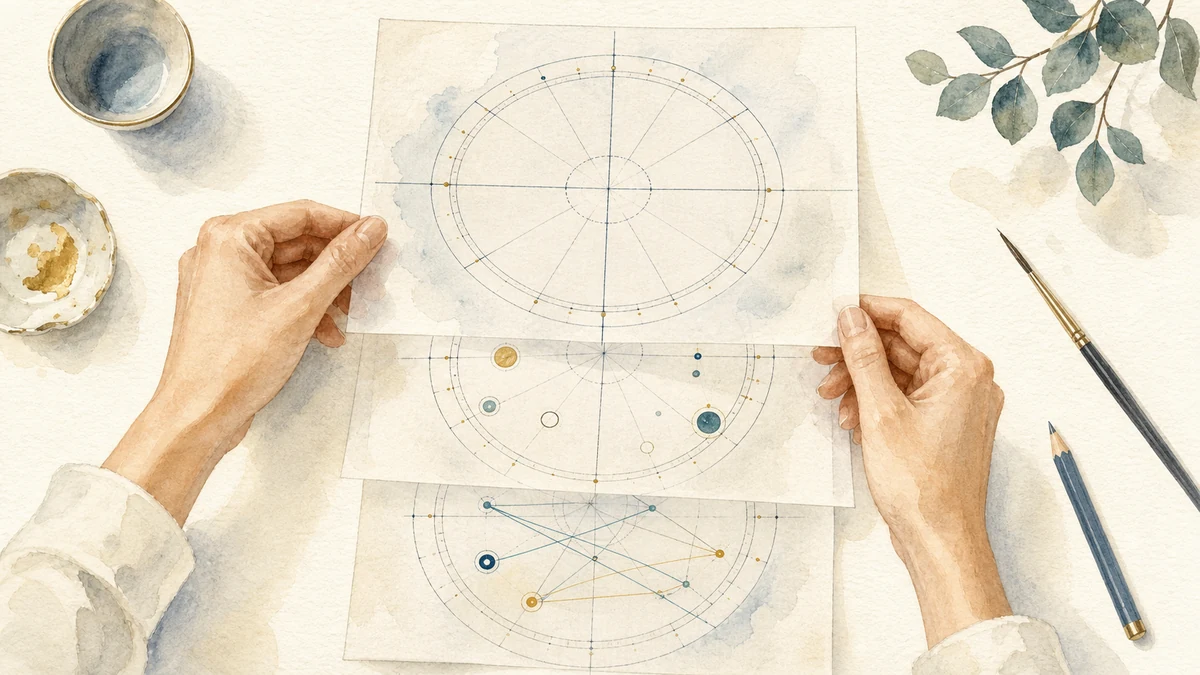
Once the input receipt is clear, move through the chart in passes. That prevents a precise-looking wheel from turning an assumption into a fact.
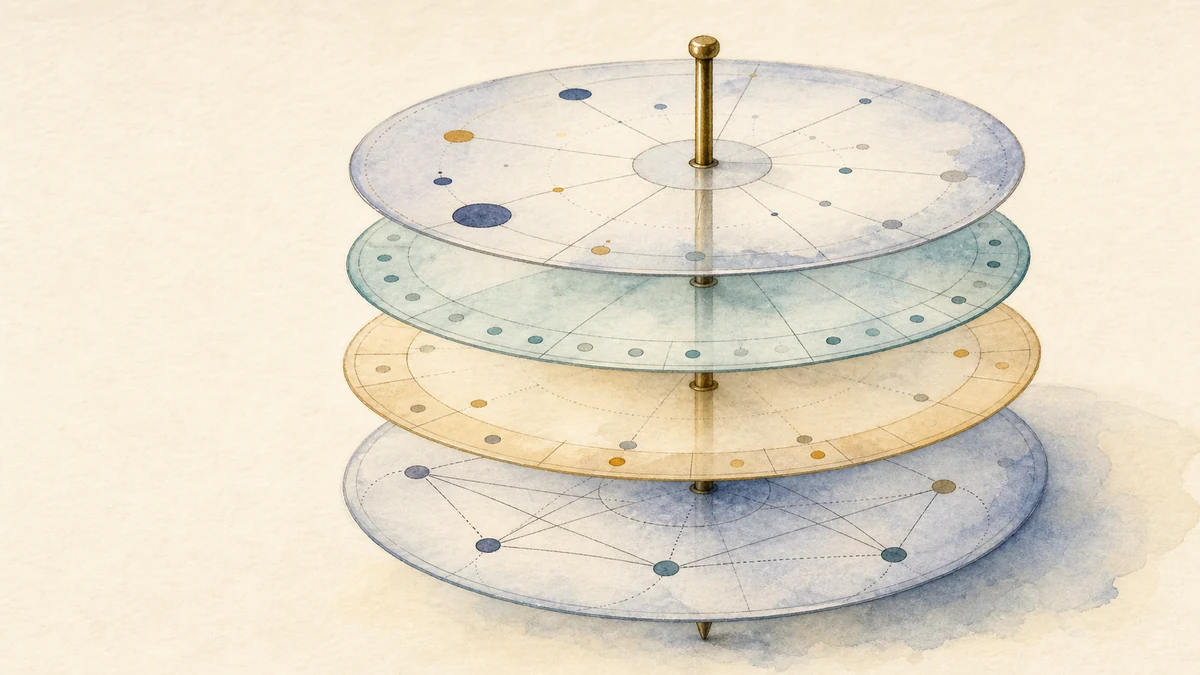
Read Planets, Signs, Houses, and Aspects as Four Different Layers
The four components answer different questions. Mixing them too early creates vague “energy” language; reading them separately creates a sentence you can test and revise.
| Layer | Question it answers | Beginner note |
|---|---|---|
| Planet | What symbolic function is involved? | Mercury: thinking and exchange; Venus: relating and valuing; Mars: effort and assertion |
| Sign | How does that function tend to operate? | Describe a style, pace, or strategy rather than a fixed personality verdict |
| House | Where in life might it become especially visible? | Use only when the time and house framework support the placement |
| Aspect | How do two functions interact? | Start with close conjunctions, oppositions, squares, trines, and sextiles involving priority planets |
A planet is not a person and a house is not an event. Within astrology, these are symbolic categories used to organize reflection. “Mars in the third house” does not prove conflict with siblings; it may prompt questions about direct speech, mental urgency, advocacy, or how effort is invested in learning and local exchange. Context decides which possibility is useful.
Signs should modify the planet rather than replace it. If Mercury is the function of thinking and communication, its sign suggests a manner of processing. The house locates a life domain. An aspect adds a relationship to another function. Keep those grammatical roles stable and you will avoid descriptions in which every keyword becomes an unrelated adjective.
Empty houses are still part of the chart. They retain a sign on the cusp and a planetary ruler within the selected system. They do not mean that the life area is absent, doomed, or irrelevant. For a first reading, occupied and angular houses are simply easier places to observe emphasis.
Likewise, an outer planet’s sign is usually a broad generational background. Make it personal only when the planet is close to an angle, occupies a prominent house under reliable time, rules a relevant point within the chosen method, or forms a tight aspect with a luminary or personal planet. This keeps a slow-moving placement from overwhelming more individual chart factors.
A Step-by-Step Birth Chart Reading Order
Use the following sequence for a first complete pass. Keep each note short enough that you can see patterns rather than accumulating a miniature encyclopedia.
1. Orient the wheel
Find the Ascendant at the eastern edge, then identify the Descendant, Midheaven, and IC. Note the sign rising and the planet that rules that sign under the rulership scheme you are using. Record where that chart ruler sits by sign and, with reliable time, by house. If the time is unknown, skip the angles and houses instead of substituting noon as fact.
2. Read the Sun and Moon separately
For each luminary, write the sign, house if supported, and closest major aspects. The Sun and Moon are not interchangeable labels for a “real self” and a “fake self.” Within many modern Western approaches, the Sun can frame conscious direction and vitality, while the Moon can frame needs, rhythms, and familiar responses. Treat these as prompts and compare them with experience.
The planned Sun Sign vs Moon Sign guide will own the deeper comparison. Here, the practical rule is to give both luminaries space before forcing them into one conclusion.
3. Add Mercury, Venus, and Mars
Read one function at a time: Mercury for thinking and exchange, Venus for attraction and values, and Mars for effort, assertion, and pursuit. Make one planet-sign-house sentence for each. Then check whether a close aspect to the Sun, Moon, Ascendant, or chart ruler changes the tone.
4. Map house emphasis
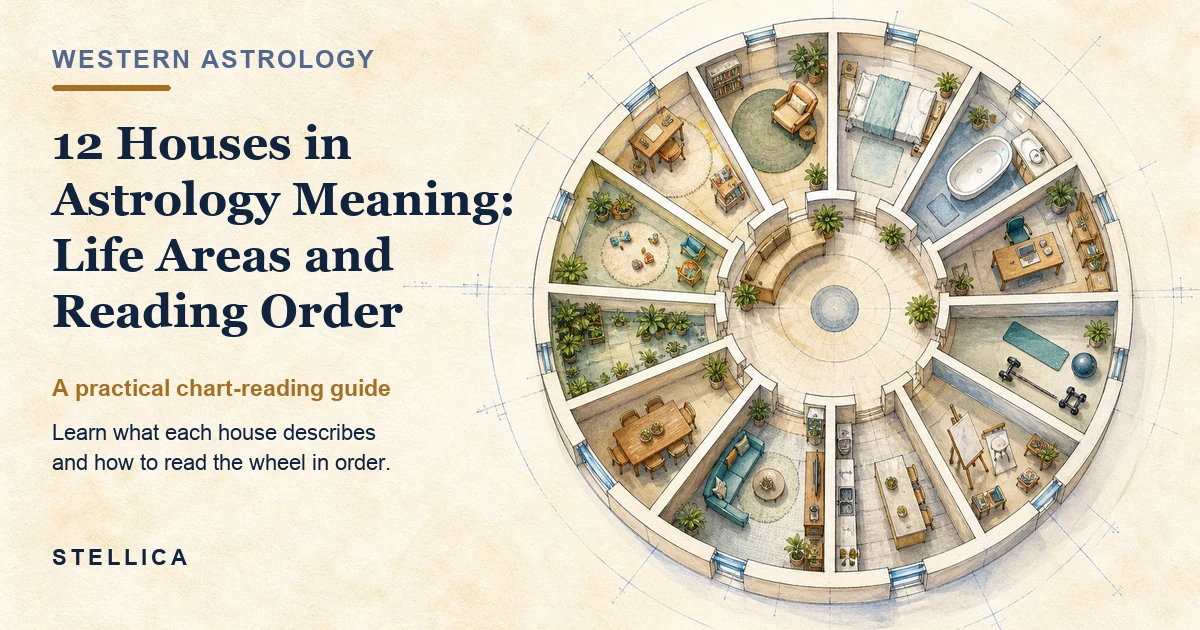
Notice occupied houses, planets close to angles, and repeated activity in one part of the wheel. Do not count placements as votes without context; three minor points do not automatically outweigh one luminary exactly on an angle. If you need a domain-by-domain lookup, the planned 12 Houses in Astrology guide will provide it without turning this method into twelve separate glossaries.
5. Select aspects instead of reading every line
Begin with the major aspects that are closest to exact and involve the planets already prioritized. Record the aspect type, the two functions, and the orb shown by the tool. An orb is a convention around an exact angle, not a universal measurement with one mandatory cutoff.
Conjunctions combine functions; oppositions create a polarity; squares can describe friction or repeated adjustment; trines can describe easier flow; sextiles can describe an available connection. None is automatically good, bad, lucky, or doomed. Astrology Aspects Explained covers angles, orbs, and aspect synthesis in more depth.
6. Look for repetition, then stop
Circle two or three themes that recur across different high-priority factors. A communication theme appearing through Mercury, the third house, and an aspect to the Moon has more support within the chart than a single isolated keyword. Write what repeats, list one counterexample, and stop before every symbol is recruited to prove the same story.
How to Synthesize a Placement Without Keyword Soup
Suppose a hypothetical timed chart shows Mercury in Taurus in the ninth house, square Saturn. Do not paste together “communication, stubborn, travel, restriction” and call that an interpretation. Build the statement in stages.
- Planet: Mercury directs attention to thinking, language, learning, and exchange.
- Sign: Taurus suggests a steady, concrete, and deliberate style within this symbolic system.
- House: With a reliable time and the selected house system held constant, the ninth house locates emphasis in higher learning, worldview, publishing, or long-distance contexts.
- Aspect: A close square from Saturn may add pressure to test, structure, delay, or carefully qualify what Mercury communicates.
A provisional synthesis could be: “Ideas may be developed slowly and tested for durability, especially in study or worldview questions; pressure to be correct can support disciplined thinking but may also make early drafts harder to release.” That sentence contains a possibility and a tension. It does not claim that the person will become a professor, fear travel, or experience a predicted setback.
Now test the sentence. Is Mercury close to the Midheaven? Does it rule the Ascendant? Are there easier aspects that add flexibility? Is the ninth-house placement stable across the recorded-time confidence and chosen system? What does the person’s actual context support or contradict? A responsible synthesis remains revisable.
Use two note columns
Keep chart observation separate from possible interpretation. In the first column, write only calculated or structural facts: “Mercury at this degree; ninth house under Placidus; square Saturn with this orb.” In the second, write one or two interpretive possibilities and a question. This makes it easier to revise the meaning without rewriting the data.
Add a third line for context if you are reading with someone: what they recognize, reject, or understand differently. Recognition is useful feedback, but it does not prove astrology scientifically or turn every remembered event into confirmation. The chart can function as a structured prompt without being treated as causal evidence.
Common Birth Chart Reading Mistakes and Better Checks
Treating every placement as equally loud
Prioritize luminaries, angles with reliable time, the chart ruler, personal planets, angular planets, and close major aspects. Give slower-planet sign placements less individual weight unless another factor makes them prominent. “More symbols” is not the same as “more evidence.”
Reading one placement as a complete personality
One placement describes one symbolic function in one context. Look for reinforcement and contradiction. A direct Mars sign does not cancel a cautious Moon, and an easy Mercury aspect does not describe every conversation. A chart is a pattern of relationships, not a set of independent personality cards.
Calling squares bad and trines good
Ease can be underused; friction can motivate practice; either can be experienced differently across contexts. Describe the relationship first. Words such as tension, coordination, repetition, or available flow are more useful than a moral score.
Treating an empty house as a missing life area
Every house exists in the wheel. An empty house has a cusp and ruler under the chosen system. It may simply receive less immediate emphasis in a first natal pass. Do not infer “no relationships,” “no career,” or another absence from emptiness.
Changing systems to chase a preferred answer
A house-system comparison can be a legitimate study exercise. It becomes confusing when unlabeled pieces are mixed or when the system changes until a desired house appears. Keep an explicit method receipt: zodiac, house system, rulership scheme, orb conventions, and birth-time source.
Turning natal symbolism into a guaranteed forecast
A natal chart is a symbolic map calculated for a birth moment. It does not guarantee an event, diagnose health, replace professional advice, or remove personal choice. Timing techniques such as transits are separate methods with their own assumptions; this beginner workflow does not use them to predict what will happen.
Frequently Asked Questions About Reading a Birth Chart
What should I read first in a birth chart?
Check the birth data and chart settings first. With a reliable time, orient the Ascendant and angles, then read the Sun and Moon. Add Mercury, Venus, and Mars, notice house emphasis, and select only the closest major aspects involving those priority factors. Finish by identifying two or three repeated themes.
Can I read a birth chart without an exact birth time?
You can examine placements that remain stable across the supported time window, but you cannot safely claim a reliable Ascendant, Midheaven, houses, or planet-in-house meanings from the date alone. The Moon and close aspects may also change. Use a clearly labeled partial chart and leave timed fields open.
Which house system should a beginner use?
Use the system supplied by your chosen calculator, name it in your notes, and keep it consistent for the reading. Placidus and Whole Sign are common in different modern practices, but neither should be silently mixed with the other. Comparison is most useful after you can distinguish stable conclusions from cusp-dependent ones.
Are squares and oppositions bad?
No. In astrological interpretation, squares often describe friction or repeated adjustment, while oppositions describe a polarity that asks for integration. They may feel demanding, but they are not moral verdicts or guaranteed misfortune. Consider the planets involved, the orb, the rest of the chart, and the person’s context.
Does a birth chart predict what will happen?
Not by itself. A natal chart organizes symbolic placements for a birth moment. Some astrologers use separate timing techniques, but those methods do not guarantee events. This article treats the chart as a reflective framework for noticing patterns and questions, not as proof of personality or a fixed future.
Summary: A Repeatable Beginner Method
- Check the birth data, time confidence, zodiac, house system, and orb conventions before interpreting the wheel.
- Read in priority order: orientation and angles when supported, Sun and Moon, personal planets, house emphasis, then selective major aspects.
- Keep the grammar clear: planet is what, sign is how, house is where, and aspect is how functions interact.
- Synthesize repeated high-priority patterns and preserve counterexamples instead of making every placement equally loud.
- Keep natal interpretations provisional, non-medical, non-deterministic, and separate from guaranteed prediction.
A careful reading is not the one with the most keywords. It is the one whose strongest claims can be traced back to reliable inputs, a named method, and a small number of coherent chart relationships.