What Are Astrology Aspects?
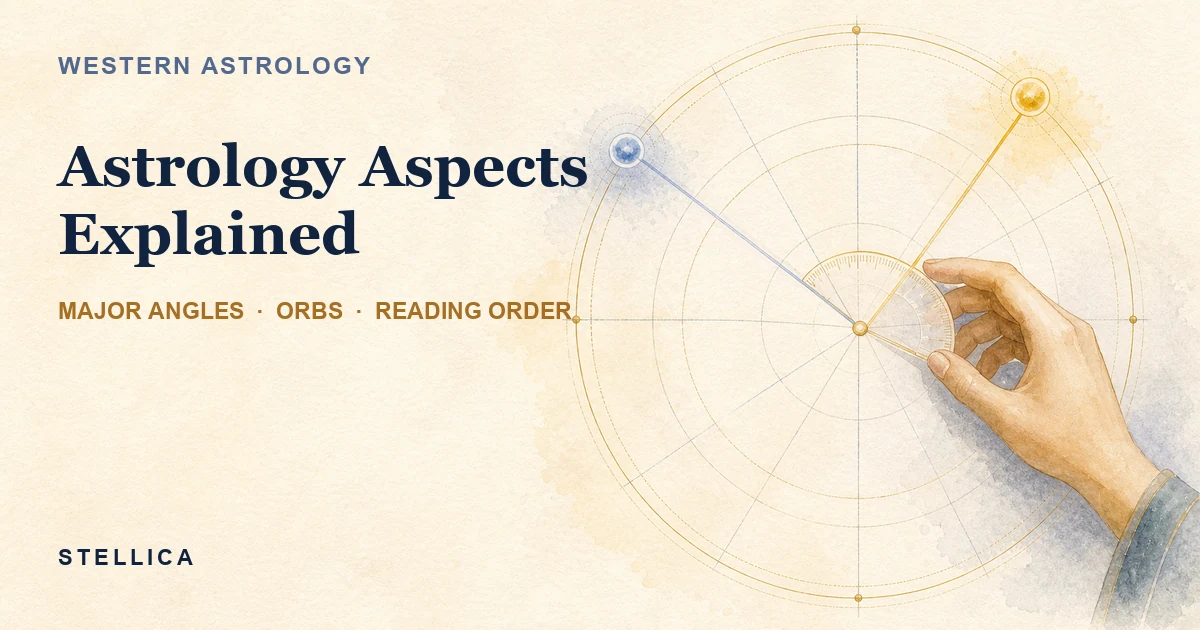
An astrology aspect is the measured angle between two planets or chart points. Readers combine that angle with the bodies involved, a declared orb, and the wider chart to describe a symbolic interaction. The major aspects—conjunction, sextile, square, trine, and opposition—are reading frameworks, not automatic scores or event predictions.
A chart is a 360-degree circle, so an aspect begins with geometry: compare the positions of two bodies, find their angular separation, and see whether it falls near a recognized angle. Interpretation comes afterward. The planets or points identify the symbolic functions involved; the aspect offers a lens for how those functions meet. Signs, houses, repetition, and the reliability of the birth data provide further context.
This order matters because an angle alone cannot identify which functions are meeting, where readers may notice the pattern, or whether other placements reliably reinforce it.
If you want a chart reference while reading, open Stellica's current Western astrology preview. This is an entry preview only, not a promise of a dedicated aspect grid, adjustable orb settings, or a complete English report.
Major Astrology Aspects and Their Angles
Beginners can start with five widely used major angles. A conjunction concentrates two functions in the same area; a sextile suggests a cooperative opening; a square highlights tension or pressure; a trine describes relative ease; and an opposition places two functions across a polarity. These are interaction lenses, not grades for a chart.
| Aspect | Exact angle | Common reading lens |
|---|---|---|
| Conjunction | 0° | Blending, concentration, or emphasis |
| Sextile | 60° | Cooperation or an opening that may need participation |
| Square | 90° | Friction, pressure, or a prompt to act |
| Trine | 120° | Relative ease, flow, or ready availability |
| Opposition | 180° | Polarity, contrast, or two ends held together |
| Quincunx context | 150° | Adjustment between functions with little shared ground |
The quincunx, also called the inconjunct, needs a boundary note. Some schools give it major status, while others place it in a secondary group. Minor aspects can add detail, but a broad catalog may hide the central relationships. Start with the five angles above, then add another aspect only when its convention and purpose are clear.
Read the Planet Pair Before the Aspect Label
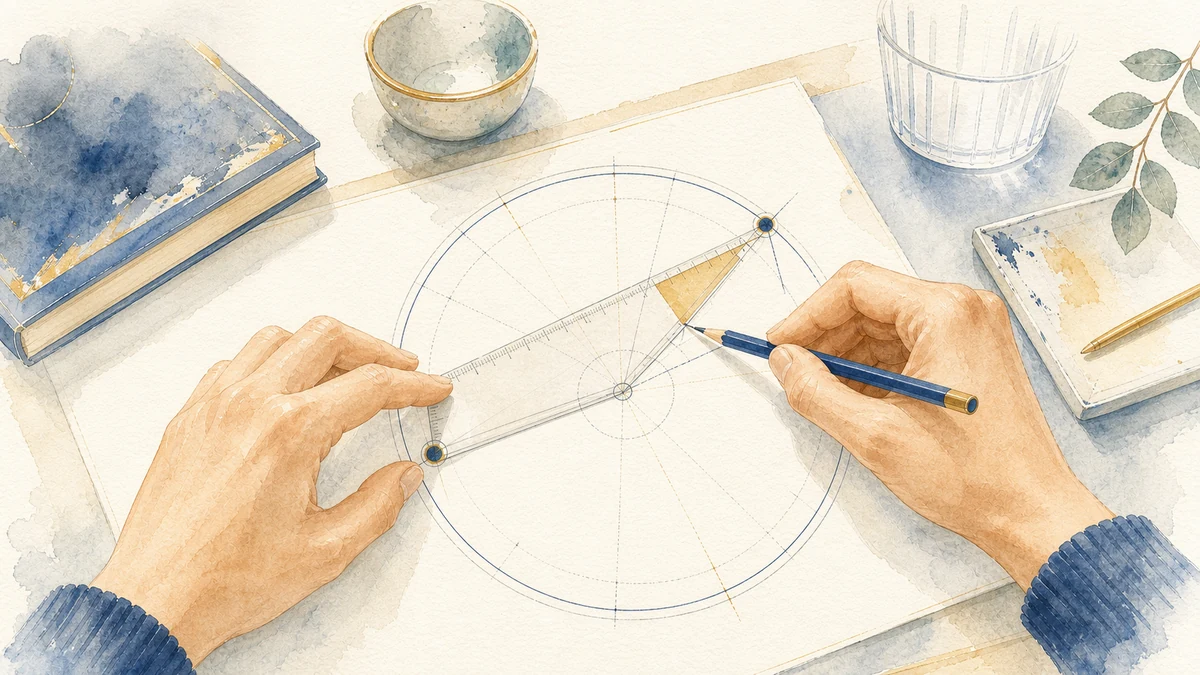
The same angle reads differently with different planets. Mercury and Saturn bring communication, structure, caution, or restraint into the conversation; Venus and Mars bring relating, attraction, preference, and action. Name both symbolic functions before attaching a conclusion. Then describe what their angle contributes: concentration, an opening, friction, ease, or polarity. This sequence prevents “square means bad” or “trine means lucky” from replacing an actual chart reading.
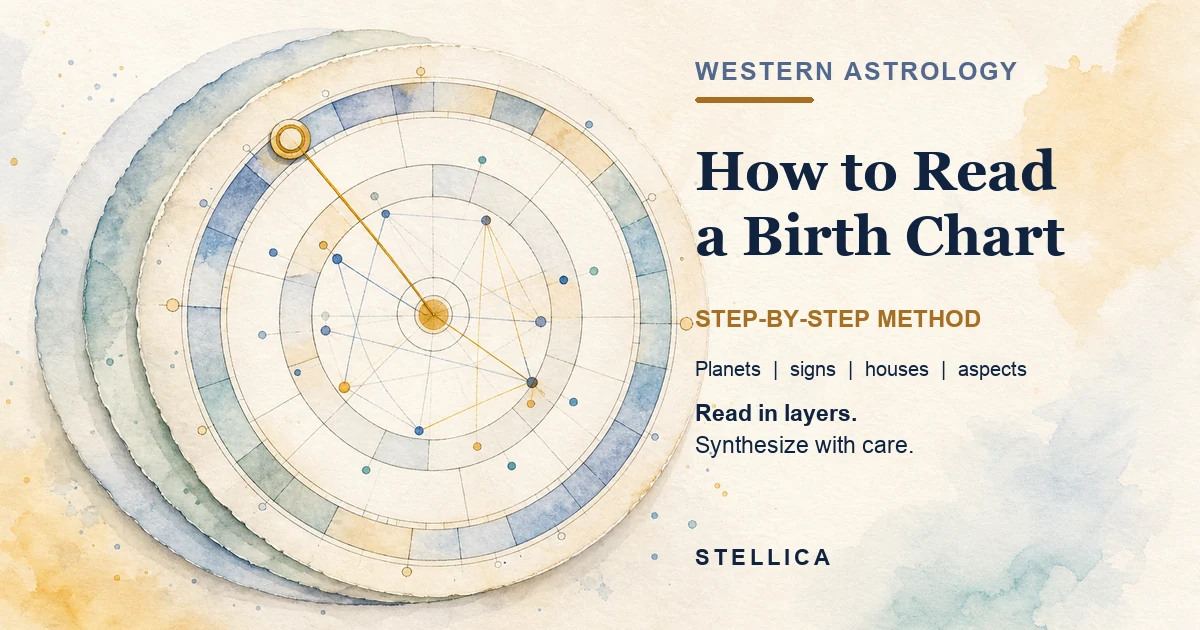
“Soft” usually groups sextiles and trines around relative ease, while “hard” groups squares and oppositions around tension or contrast. Ease may be familiar enough to overlook, and tension may prompt practice or negotiation. Neither label guarantees an outcome. Conjunctions are commonly treated as emphasis whose tone depends on the bodies involved. For the broader sequence beyond aspects, How to Read a Birth Chart is Coming soon.
Keep angles visible while choosing each interpretive lens.
STELLICA APP
Stellica previewExplore a Western astrology preview
Try the Western astrology previewHow Orbs, Applying, and Separating Change the Reading
An aspect can be recognized without being mathematically exact. The orb is the absolute difference between the observed separation and the exact aspect angle. If two planets are 123 degrees apart, the separation is three degrees away from a 120-degree trine, so the orb is 3 degrees. The arithmetic is simple; the allowed limit is a convention.
| Example only | Observed separation | Exact angle | Calculated orb |
|---|---|---|---|
| Trine comparison | 123° | 120° | 3° |
| Square comparison | 88° | 90° | 2° |
Orb limits vary by school, chart purpose, aspect type, and the bodies or points involved. Some astrologers allow more room for the Sun or Moon and less for minor aspects; others use one documented set for consistency. No single cutoff is universal. A tighter orb can help prioritize attention, but it does not make a reading more certain or louder in an objective sense.
The table demonstrates calculation, not permission. A report can agree on the separation yet classify the relationship differently because its orb policy differs. Record the exact angle and chosen allowance so another reader can follow the comparison.
When software supplies the aspect list, save its orb settings before comparing interpretations. A hidden default can add or remove a line even when the underlying planet positions agree. Recheck the same pair with one documented allowance, then describe the first point of divergence. This keeps a disagreement about settings from being retold as a disagreement about the chart itself.
Applying and Separating Are Secondary Context
An applying aspect is moving toward exactness, while a separating aspect has passed exactness. Astrologers usually assess the faster body's motion relative to the slower body. Within astrological practice, applying can be read as building and separating as familiar or moving away from a peak. This is a secondary interpretive lens, not a certainty scale. Read the planet pair, angle, and orb first, then use motion only when the chart method supports it.
A Practical Order for Reading Aspects
Long aspect lists become noisy quickly. A fixed order keeps a striking symbol or a loose minor aspect from taking over the whole chart. Work from the clearest relationship toward wider context, and record what you are adding at each step.
A written shortlist makes it easier to revisit assumptions without changing the orb rule or promoting an aspect midway.
1. Name the Planets or Points
Start by identifying both symbolic functions. Give early attention to the Sun, Moon, and personal planets, then consider slower planets and calculated points. Add the Ascendant or Midheaven only when the recorded birth time supports them. When the time is uncertain, Birth Chart Without an Exact Birth Time owns the fuller input boundary.
2. Prioritize Major and Tighter Aspects
Read conjunctions, sextiles, squares, trines, and oppositions before expanding into minor aspects. Within the selected set, compare the documented orbs and begin with tighter relationships. Priority means “read earlier,” not “more fated.” Keep looser or secondary items available for a later pass instead of forcing every line into the first interpretation.
3. Add Sign and House Context
Build a sentence in layers: planet A, planet B, style of interaction, then how and where that relationship may appear. Signs describe how the functions operate; houses describe life areas, provided the input supports the house calculation. For house-by-house language, 12 Houses in Astrology Meaning is Coming soon.
4. Look for Repetition Before Concluding
One aspect supplies a prompt, not a complete portrait. Note whether a similar tension, ease, emphasis, or polarity appears through other placements. Repetition can make a theme more useful to explore, yet it still does not fix a personality or guarantee an event. Summarize two or three recurring ideas, then compare those ideas with lived experience and ordinary evidence.
Before writing a synthesis, build a small aspect receipt. List the two bodies, exact angle, selected orb limit, measured orb, applying or separating status when supported, and any reliable house context. Then write one neutral interaction sentence and one observation question. This separates what the chart calculates from what the reader infers, so a later orb change or corrected birth time can be traced without rewriting the whole interpretation.
If several aspects seem to say the same thing, identify the shared planet or point before counting them as independent evidence. Three lines involving Saturn, for example, may describe one repeated symbolic focus rather than three unrelated conclusions. Record the overlap, keep exceptions visible, and test the synthesis against more than one situation.
Patterns, Natal Aspects, and Transit Boundaries
Several planets can create a configured pattern, but the shape is a summary rather than a shortcut. Confirm that every required pair meets the orb convention being used before naming the pattern. Then return to the bodies, signs, and houses that build it.
- A grand trine links three trines and is commonly read through reinforcement or ease.
- A T-square combines an opposition with two squares and identifies an apex within the configuration.
- A grand cross combines two oppositions and four squares across four points.
- A kite adds an opposition and two sextiles to a grand trine.
- A yod combines two quincunxes with a sextile and emphasizes repeated adjustment around an apex.
Patterns matter most when they clarify repetition already visible in the component aspects. They should not become dramatic labels detached from the actual planet pairs or the chosen orb rules. The following sequence keeps those layers visible and separates natal interpretation from any transit layer.
Natal and Transit Layers Answer Different Questions
Natal aspects compare positions within the birth chart and are commonly used to reflect on recurring symbolic dynamics. Transit aspects compare current positions with natal positions or with one another, adding a time-based layer. They should not be merged into one fixed verdict, and neither layer establishes that a specific event must happen. Stellica's CTA here remains limited to the current Western astrology preview; it does not promise transit forecasting, custom settings, or predictive certainty.
Frequently Asked Questions
What is an aspect in astrology?
An aspect is a measured angle between two planets or chart points. Astrologers pair that geometry with the bodies involved and an allowed orb, then use it as a symbolic lens for interaction.
Which angles are the major aspects?
The usual beginner set is conjunction at 0 degrees, sextile at 60, square at 90, trine at 120, and opposition at 180. Some schools also prioritize the 150-degree quincunx.
What is an orb, and how wide should it be?
An orb is the difference between an observed separation and an exact aspect angle. There is no universal maximum. Use a documented convention suited to the bodies, aspect type, and chart purpose.
Are hard aspects always bad?
No. “Hard” is conventional shorthand for tension, pressure, or contrast. A square or opposition may identify a recurring negotiation or prompt for action. “Soft” does not guarantee benefit.
What is the difference between applying and separating aspects?
An applying aspect is moving toward exactness; a separating aspect has moved past it. Astrologers use that motion as secondary context after the planet pair, angle, and orb. The distinction does not measure certainty or guarantee timing.
How should multiple aspects be prioritized?
Start with the planet pairs, then major and tighter aspects. Add reliable angles, signs, and houses before minor aspects or named configurations. Finally, look for repeated themes and keep natal structure separate from any transit comparison.
Summary
Use aspect language as a reading sequence, not a score. Keep the bodies, angle, orb convention, input limits, and chart layer visible while comparing themes without turning symbols into verdicts.
- Aspects describe measured angular relationships between planets or chart points.
- Major-angle labels organize interaction; they do not grade a chart as good or bad.
- Orb rules vary, so the convention and arithmetic should remain visible.
- Read planet pairs and tighter major aspects before adding patterns, houses, and transit context.