Life Path Number 2 meaning centers on cooperation, sensitivity, mediation, and the patient work of building trust. A balanced 2 notices what a group or relationship needs while keeping a clear point of view. The growth edge is not becoming tougher or louder; it is making preferences, limits, and disagreement visible before harmony turns into self-erasure.
If your result is 2—or you want to confirm it before reading further—try Stellica's English numerology diagnosis. Keep the calculation trail beside the interpretation so you can use the page as a reflection guide, not a personality verdict.
Life Path Number 2 Meaning in Everyday Life
Two is the first number in the Life Path sequence that immediately suggests relationship: one point and another point, one voice and another voice, action and response. In modern numerology, Life Path 2 is commonly used to explore cooperation, receptivity, diplomacy, emotional detail, and the ability to coordinate people who do not begin from the same position.
That description is often flattened into “the peacemaker.” The label captures part of the pattern, but it can hide the work involved. Good mediation is not passive. It requires noticing competing needs, listening without instantly taking a side, deciding what can be negotiated, and saying what cannot. A person who creates an agreement that people can actually keep is shaping the outcome, even if they are not the loudest person in the room.
Sensitivity is equally easy to misunderstand. Here it means a low threshold for noticing information: tone, timing, hesitation, small inconsistencies, who has not spoken, or how a decision lands after the meeting ends. That information can support empathy and judgment. It can also become exhausting when every signal feels like a personal responsibility. The useful skill is not to stop noticing. It is to decide which signals belong to you, which need a direct question, and which can pass without action.
Life Path 2 is therefore not a guarantee of kindness, intuition, shyness, romance, or emotional accuracy. A sensitive person can misread a cue. A cooperative person can avoid a necessary conflict. A patient person can postpone a choice until circumstances make it for them. The number is most useful when it names both a capacity and the conditions that keep that capacity healthy.
In short, the 2 pattern can be expressed as three moves:
- Notice more than one position. Make room for information that a single viewpoint misses.
- Connect without disappearing. Build common ground while retaining a preference and a limit.
- Coordinate a workable next step. Turn understanding into an agreement, task, repair, or decision.
This pattern may appear in a partnership, friendship, family, team, creative collaboration, or quiet solo decision. A person does not have to be sociable all the time to relate to 2. They may need substantial solitude precisely because they take in so much relational information.
STELLICA APP
Stellica previewExplore Stellica’s English diagnosis previews
Explore English previewsSensitivity as Information: Strengths and Pressure Points
The most helpful way to read Life Path 2 strengths is as a set of processes rather than flattering adjectives. “Empathic” is vague until it becomes an observable action: reflecting back what someone said, noticing a mismatch between words and pace, or asking the colleague who was interrupted to finish a point. “Diplomatic” becomes useful when it means naming the shared goal without pretending the disagreement has vanished.

The image illustrates influence without performance. The quieter contribution does not become valuable only after someone speaks loudly. The practical 2 task is to adjust the conditions—pace, turn-taking, question, or agenda—so relevant information can enter the decision. That is facilitation, not merely being nice.
Attunement and discernment
Attunement helps a person register subtle changes. It can improve timing, care, editing, negotiation, and quality review. Under pressure, the same openness can become absorption: another person's disappointment feels like a command, tension becomes proof that something is wrong, or a neutral pause is interpreted as rejection.
A discernment check interrupts that slide:
- What did I actually observe?
- What meaning did I add?
- Is this mine to address, theirs to address, or shared?
- Would a direct question produce better information than another hour of interpretation?
This check respects sensitivity while refusing to treat every impression as fact.
Cooperation and self-abandonment
Cooperation is a genuine strength when it combines perspectives or distributes work fairly. It becomes self-abandonment when agreement is purchased by hiding a preference. The short-term room may feel calmer, but the unspoken cost returns as resentment, withdrawal, fatigue, or an agreement the person cannot sustain.
For a 2-oriented reader, a visible preference can be modest and still clear: “I can help for one hour, not the whole afternoon.” “I want to hear both options before deciding.” “I agree with the goal, but not with that deadline.” None of these statements is aggressive. They give the relationship information it needs to work.
Patience and delayed decisions
Patience can protect a process from impulsive reactions. It allows evidence to accumulate and gives other people time to formulate a response. Yet patience without a review point becomes drift. The person waits for perfect consensus, a conflict-free option, or a feeling of certainty that never arrives.
Use a decision deadline that fits the stakes. Low-risk choices may need ten minutes. A job change may need a week of research. The 2 skill is not instant certainty; it is choosing when additional listening will improve the decision and when it will only postpone ownership.
Loyalty and invisible labor
Loyalty helps relationships survive ordinary inconvenience. Invisible labor—remembering, smoothing, anticipating, checking, translating—can make a household or team function. The problem begins when that labor is expected, uncredited, or impossible to stop without everything falling apart.
Name the work before negotiating it. “I am tracking the follow-ups, preparing people before meetings, and checking how decisions land afterward” is more actionable than “I do everything emotionally.” Once the work is visible, it can be shared, scheduled, recognized, or intentionally reduced.
The middle stage is the one many peacemaker descriptions omit. Listening to the other person is not enough; the reader must also consult the self who will live with the agreement. Only then can cooperation include two people rather than one person and a well-managed absence.
A strength-to-reset reference
| Capacity | Helpful expression | Overextended pattern | Reset question |
|---|---|---|---|
| Sensitivity | Notices context and emotional detail | Treats every cue as a duty or fact | “What did I observe, and what am I assuming?” |
| Diplomacy | Translates positions and finds workable overlap | Softens the issue until no one can respond to it | “Can I name the disagreement in one plain sentence?” |
| Patience | Allows timing and evidence to improve a choice | Waits for universal comfort or certainty | “What is the decision deadline?” |
| Support | Helps another person succeed | Performs unbounded, invisible labor | “What exactly am I offering, and for how long?” |
| Loyalty | Stays present through ordinary difficulty | Remains in an unsafe or chronically unequal pattern | “Is repair happening in behavior, not only in promises?” |
| Collaboration | Combines information and shares ownership | Gives away authorship or credit | “Where is my contribution named?” |
None of these rows proves that every Life Path 2 will show the pattern. They are prompts for observation. Choose the row that describes a real situation, then test one reset in behavior.
Recovery after people-intensive attention
Relational attention has a cost even when the interaction goes well. A person who tracks tone, participation, ambiguity, and follow-up may leave a meeting with more unfinished processing than someone who focused only on the agenda. Calling that person “too sensitive” misses the design problem: the work required attention that the schedule did not allow them to release.
Build a transition instead of waiting for exhaustion. After a dense conversation, take five minutes to sort three categories: action, question, and not mine. Put promises you made under action. Put uncertain cues that require direct clarification under question. Put another adult's mood, unspoken preference, or decision under not mine unless they explicitly ask for help. This prevents the nervous system from treating every remembered detail as an open task.
Recovery can also be sensory and practical: ten quiet minutes, a walk without another call, written notes instead of immediate discussion, or a protected block of individual work after facilitation. The point is not to turn sensitivity into a fragile identity. It is to match attention-heavy work with a realistic reset, just as physical work requires recovery time.
Notice the difference between restoration and withdrawal. Restoration has a return: “I need twenty minutes, then I can review the plan.” Withdrawal leaves everyone guessing and often increases the relational uncertainty that a 2-oriented person finds difficult. A clear return time protects solitude without making another person responsible for chasing connection.
If you routinely need hours to recover from ordinary contact, investigate the actual conditions rather than assuming numerology explains them. Workload, conflict, masking, noise, sleep, health, anxiety, trauma, access needs, or an unsafe environment may be relevant. A Life Path theme is not a diagnosis and should never delay appropriate support.
Life Path 2 in Love, Friendship, Family, and Conflict
Relationship content dominates searches for Life Path 2 because partnership is the obvious symbolic theme. The useful version of that content goes beyond “2 is loving.” Love is not measured by how quickly someone anticipates another person's needs, how rarely they disagree, or how much discomfort they absorb. A stable relationship needs affection and usable information.
What 2 may offer in relationships
A 2-oriented partner or friend may remember small preferences, notice shifts early, create space for conversation, or help two people hear each other more accurately. They may value consistency, mutual check-ins, shared rituals, and a sense that decisions are made with rather than around them. These are contributions, not automatic traits, and they work best when the other person reciprocates attention.
The contribution can be quiet enough to disappear from view. A person who prepares the difficult conversation, adjusts the timing, checks on everyone afterward, and repairs misunderstandings may be doing substantial relational work. Naming that work is not scorekeeping. It allows both people to decide how it should be shared.
Making a quiet preference audible
The most common 2 tension is not simply “poor boundaries.” It is the gap between having a preference and making it available to the relationship. Someone may know exactly what they want but present it as a tentative hint, then feel unseen when the hint is missed. Or they may wait to learn the other person's preference before editing their own into a compatible shape.
Try a preference before a compromise:
- “My first choice is Saturday morning.”
- “I want a quieter plan tonight.”
- “I need time to think, and I will answer by tomorrow.”
- “I am willing to change the method, but I want the goal to stay.”
These statements do not prevent negotiation. They give negotiation something real to work with.
Conflict pacing
Conflict can overwhelm a person who detects tone and implication quickly. One response is to solve the other person's discomfort before understanding the issue. Another is to go silent, appear agreeable, and process the disagreement hours later. Neither response means the person is incapable of conflict; it means the pace exceeded their ability to stay present.
A pacing agreement can help: either person may request a pause, the person requesting it names a return time, and the conversation resumes with one issue at a time. A pause without a return becomes avoidance. Immediate discussion without regulation can become flooding. The agreement protects both continuity and capacity.

The mediator in this scene is not responsible for making both groups happy. Their task is narrower and more realistic: slow the exchange, separate positions from needs, and identify what decision is actually required. The same distinction helps in intimate relationships. Understanding both sides does not create an obligation to accept both requests.
A four-step repair conversation
- State the observation. “We changed the plan twice after I had rearranged my day.”
- Name the impact without mind-reading. “I felt unimportant and became less willing to help.”
- Make a specific request. “If the plan may change, tell me before noon.”
- Define the follow-through. “If I do not hear by then, I will keep my original schedule.”
This structure may feel unusually direct to someone accustomed to maintaining atmosphere. Its kindness lies in reducing ambiguity. The other person can respond to a concrete request, and the speaker does not have to keep broadcasting distress through silence or over-accommodation.
The flow also reveals whether repair is mutual. If one person repeatedly names, asks, and follows through while the other refuses every agreement, the issue is not insufficient diplomacy. Numerology should never be used to explain away coercion, contempt, chronic dishonesty, or harm as a “compatibility lesson.” Safety and observable behavior matter more than a number pairing.
Friendship and family roles
In friendship, a 2 pattern may show up as the person who maintains the thread, remembers context, or brings a quieter friend into the conversation. A healthy friendship notices that contribution and makes room for the 2-oriented person to need support without first demonstrating usefulness.
In families, a child or adult may be recruited as the translator between people who will not speak directly. Mediation can become an identity: “I am safe when everyone else is okay.” A more sustainable role is optional and bounded. “I can help you prepare what you want to say, but I will not carry the message” keeps care without accepting ownership of another person's relationship.
The same principle applies to romance. Devotion is not measured by endurance alone. A relationship that works for a 2-oriented person should permit explicit needs, separate time, imperfect conversations, and disagreement that does not threaten belonging.
Boundary language for four common moments
“Set a boundary” is poor advice when the reader does not know what to say. A usable boundary contains information about your action or capacity; it is not a demand that the other person feel differently.
When someone asks for help: “I can listen for fifteen minutes, but I cannot mediate between you and them.” This separates care from a role you do not accept.
When you need time: “I am not ready to answer now. I will decide by 6 p.m. tomorrow.” The deadline prevents reflection from becoming indefinite waiting.
When a plan keeps changing: “If the time changes after noon, I will not be able to attend.” The sentence does not forbid change. It states what you will do under a predictable condition.
When emotional intensity rises: “I want to continue, and I cannot do it while we are interrupting each other. I am taking a thirty-minute pause and will return at eight.” The return protects the relationship; the condition protects the conversation.
Expect discomfort after a new boundary. A 2-oriented person may interpret another person's disappointment as proof that the limit was unkind. Disappointment can simply mean the other person preferred a different answer. Ask whether the boundary was clear, proportionate, and followed—not whether it produced immediate harmony.
Follow-through matters more than perfect wording. If you repeatedly stay after saying you will leave, the sentence teaches both people that the limit is negotiable through pressure. Begin with a small boundary you can keep. Consistency builds credibility and reduces the need for dramatic escalation later.
It is also possible to overuse boundary language as a shield against mutual responsibility. “That is your feeling” can be technically separate and relationally evasive when your behavior caused a clear impact. Boundaries and repair belong together: you can decline responsibility for controlling another person's emotion while accepting responsibility for a broken promise, harsh remark, or neglected agreement.
Life Path 2 at Work: Contribution, Credit, and Decisions
Career lists for Life Path 2 often name counseling, teaching, diplomacy, administration, care work, design, or support roles. Those examples point to real capacities, but they are too narrow to prescribe a career. Cooperation and detail sensitivity can matter in engineering review, product research, editing, operations, law, health care, project management, music, entrepreneurship, or any setting where multiple perspectives must become a coherent decision.
The more useful question is: What conditions let relational intelligence become visible work rather than endless availability?
Facilitation and synthesis
A 2-oriented contributor may be skilled at hearing the requirement behind a confusing request, summarizing a disagreement without inflaming it, or connecting two people whose work has drifted apart. This is synthesis. It produces deliverables: a clarified brief, a decision log, a risk list, a revised process, or an agreement about ownership.
Make the output visible. Instead of “I helped everyone communicate,” record “I facilitated the decision, documented three constraints, and turned them into the approved brief.” Visibility is not self-promotion for its own sake. It lets a team allocate responsibility and credit accurately.
Review and quality sensitivity
Sensitivity can support editing, testing, service design, conflict prevention, and risk review. A person may notice a confusing phrase, an exclusion in a process, or a stakeholder who will be affected by a decision but is missing from the room. This work is valuable when the organization has a path for acting on it.
In a culture that asks for feedback but punishes unwelcome information, the same sensitivity becomes exhausting. The worker keeps detecting issues without authority to resolve them. Before accepting a role or project, ask how feedback is reviewed, who decides, and what happens when the reviewer and owner disagree.
Invisible labor and role creep
Because a 2-oriented person can make collaboration smoother, they may become the default note-taker, emotional monitor, onboarding guide, or scheduler regardless of job title. Each task may be small, but together they consume focus and rarely appear in evaluation criteria.
Audit the work for two weeks. List tasks that maintain relationships or coordination, estimate time, and mark which are expected, volunteered, or assigned by habit. Then choose one response: formalize the responsibility, rotate it, stop it, or exchange it for another task. “I can facilitate this meeting if someone else owns the notes and follow-up” is a complete professional boundary.
Decision-making without perfect consensus
Workplaces rarely offer the harmony implied by a peacemaker archetype. Good decisions may disappoint someone. A 2-oriented decision process benefits from three categories:
- Consult: whose information must be heard before deciding?
- Decide: who owns the final call and the consequences?
- Communicate: who needs the rationale, even if they did not choose the result?
Separating those categories prevents consultation from becoming a promise of unanimity. It also allows the 2 contributor to respect multiple perspectives without pretending they can all control the outcome.
Leadership without dominance
Life Path 2 is often described as support rather than leadership. That contrast assumes leadership must be loud, individual, or heroic. Relational leadership may set a fair process, distribute speaking time, surface risk, maintain an alliance, or protect a team from avoidable confusion. It can be decisive precisely because it understands how implementation depends on people.
The growth edge is to own the decision as clearly as the process. “I heard the concerns, and I am choosing option B for these reasons” prevents collaborative leadership from dissolving into endless facilitation.
Make relational work legible through artifacts
Invisible labor becomes easier to value when it leaves a useful artifact. The artifact should support the team's decision, not exist only to prove that you were busy.
A facilitation brief records the question, participants, constraints, decision owner, and result. A decision log states what was chosen, what evidence informed it, what objections remain, and when the choice should be reviewed. A responsibility map distinguishes who owns the task, who must be consulted, and who only needs the outcome. A follow-up register lists promises with names and dates so the facilitator does not become the private memory of the group.
These documents change the sentence “I kept everyone aligned” into observable work. They also reveal when the role is too broad. If one person is preparing the room, interpreting tension, recording decisions, reminding owners, and repairing every missed handoff, the process has concentrated multiple jobs in a single cooperative person.
Bring evidence to a workload conversation. For example: “Over the last month I facilitated six cross-team decisions, produced the briefs, and tracked twenty-three follow-ups. That work took about a day each week and is not in the current project estimate. We need to reduce the scope, rotate follow-up ownership, or recognize facilitation as part of my role.” Specifics make negotiation possible without requiring the manager to agree with a numerology description.
Credit should also be precise. The 2-oriented pressure pattern can be giving away authorship because the result was collaborative. Collaboration does not erase contribution. Use verbs that name it: synthesized, facilitated, reconciled, edited, negotiated, reviewed, or coordinated. “I synthesized five stakeholder interviews into the final requirements” gives appropriate credit while acknowledging the source material.
When “easy to work with” becomes an occupational hazard
Being easy to work with can mean responsive, respectful, and clear. It can also mean the person absorbs ambiguity and inconvenience so no one else has to improve the process. They accept the late request, translate the vague brief, repair the conflict privately, and deliver on time. The team experiences ease; the worker experiences chronic hidden complexity.
Before rescuing a request, expose one piece of the complexity. Ask which deadline has priority, who approves the tradeoff, or what existing work should move. The aim is not to become obstructive. It is to return the cost to the decision where it belongs.
A practical sentence is: “I can add this by Friday if we remove the reporting section, or I can keep the full scope for Tuesday. Which outcome do you want?” This converts accommodation into a visible choice. The requester participates in the tradeoff rather than receiving invisible overtime as proof of cooperation.
Work conditions to evaluate
| Condition | Helpful question for a 2-oriented reader |
|---|---|
| Collaboration | Are roles and decision rights clear, or is harmony expected to replace them? |
| Feedback | Can concerns be raised without punishment, and who acts on them? |
| Credit | Are facilitation, review, and relationship work included in evaluation? |
| Focus | Is there protected individual time after people-intensive work? |
| Boundaries | Can availability be defined, or is responsiveness treated as character? |
| Conflict | Does the team repair disagreements, or reward whoever pushes hardest? |
These questions can inform a career decision, but they do not guarantee fit. Skills, interests, access, pay, health, caregiving, local conditions, and evidence from actual work remain essential.
Life Path 2 Compatibility: Dynamics, Not Verdicts
Compatibility pages often sort numbers into ideal, uncertain, and difficult matches. That format is easy to scan and too easy to mistake for a relationship forecast. A Life Path number cannot measure consent, honesty, shared values, safety, attraction, skill, timing, or willingness to repair. The useful part of compatibility is the question a pairing raises.
For Life Path 2, four dimensions matter more than a ranked list:
- Pace: How quickly does each person decide, speak, or change course?
- Visibility: Are quiet preferences invited and then stated clearly?
- Autonomy: Can care and connection coexist with separate choices?
- Repair: What happens after tension—pursuit, withdrawal, blame, pause, or a workable return?
The table below offers prompts, not predictions.
| Other Life Path style | Possible ease | Possible friction | Better question |
|---|---|---|---|
| 1 — initiative | 1 may name direction while 2 adds context and coordination | 2 may disappear behind 1's speed; 1 may read processing as resistance | “How will consultation change the decision, and who decides?” |
| 2 — attunement | Both may value care, patience, and mutual awareness | Each may wait for the other to state a preference or start conflict repair | “Can each person make a first-choice request before compromising?” |
| 3 — expression | 3 can bring language and play; 2 can listen for nuance | 3's pace may overwhelm; 2's indirectness may leave 3 guessing | “How do we make room for both expression and unhurried response?” |
| 4 — structure | 4 may offer consistency; 2 may make agreements relationally workable | 4 may prioritize the plan while 2 silently absorbs its cost | “When circumstances change, who can reopen the agreement?” |
| 5 — variety | 5 can widen options; 2 can help name relational consequences | 2 may experience changes as instability; 5 may experience check-ins as control | “What freedom is protected, and what notice does trust require?” |
| 6 — care | Both may value responsibility and a supportive environment | Care can become overfunctioning, rescuing, or unspoken debt | “How do we receive help and redistribute care before exhaustion?” |
| 7 — depth | 7 may appreciate 2's patience; 2 may respect thoughtful privacy | 2 may personalize distance; 7 may feel over-read or pursued | “How will space be requested, and when will connection resume?” |
| 8 — execution | 8 may supply decisive action; 2 may surface human impact | Power can become uneven if 2 handles consequences without authority | “Are influence, resources, and credit transparent?” |
| 9 — breadth | Shared compassion can support meaningful contribution | Both may overgive or treat personal needs as less important than a cause | “What limit protects care from becoming depletion?” |
An active comparison with Life Path Number 1 is especially useful because it makes autonomy and cooperation visible without calling either better. The planned Life Path Number 6 meaning guide will explore reciprocal care, while the planned Master Number 11 meaning guide owns the fuller 11/2 distinction. Until those articles are published, their local preview links should remain visibly inactive.
Compatibility becomes actionable only when the prompt leads to behavior. If pace differs, agree on notice. If one voice disappears, change turn-taking. If responsibility is uneven, list and redistribute it. If repair never happens despite repeated clear requests, the number pairing is not an explanation that must be endured.
Life Path 2, Master Number 11/2, and “I Don't Relate”
An ordinary Life Path 2 and a retained 11 are connected by reduction because 1 + 1 = 2. Many numerology traditions therefore discuss 11 with a 2 base: cooperation, sensitivity, receptivity, and balance may remain relevant context. Eleven is also commonly interpreted through inspiration, intensity, or translating impressions into a message.
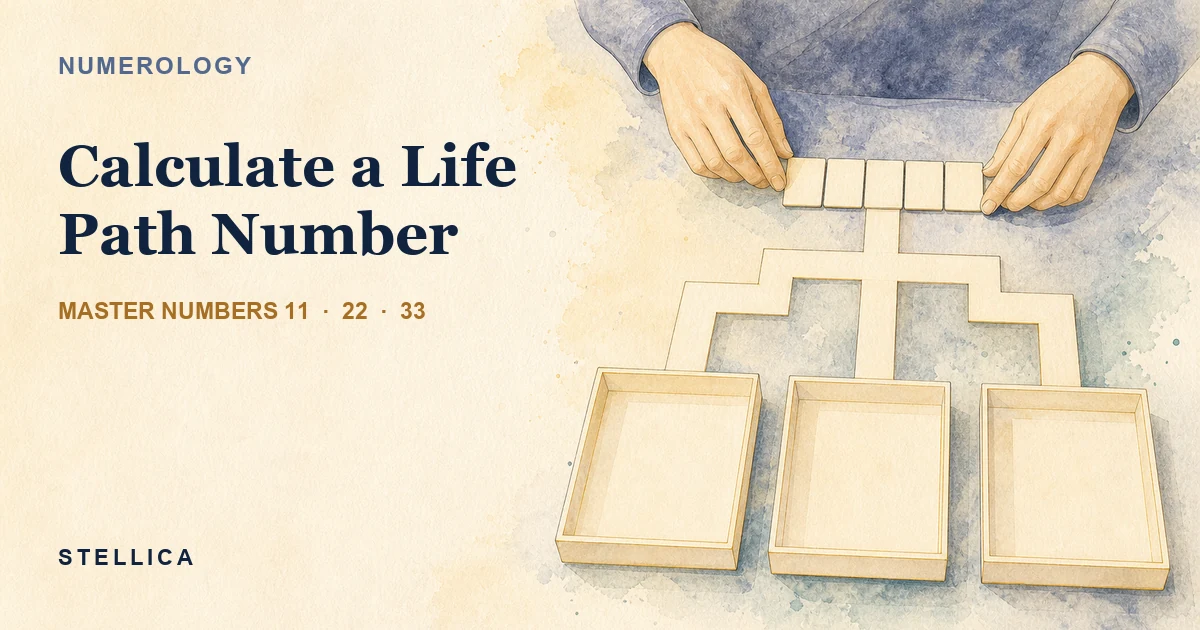
The connection does not mean every 2 is secretly an 11, that 11 is an upgraded 2, or that someone can choose the label that feels more important. Under Stellica's convention, the arithmetic trail must actually reach 11 at a retained stage. The calculation guide for 11, 22, and 33 shows exactly where the stop check occurs and why other grouping rules may produce a different result.
If your result is 2 and the description does not fit, check four things before searching for a more flattering number:
- Input: Was the complete birth date entered correctly?
- Method: Did the calculator add all digits first or reduce date parts separately?
- Position: Are you reading a Life Path interpretation, not a Birthday or name-number meaning?
- Scope: Does the description claim a fixed personality when the position is better used as a broad developmental theme?
After that, allow non-resonance. Perhaps cooperation is a skill learned through difficulty rather than an obvious temperament. Perhaps sensitivity appears in quality control rather than emotion. Perhaps the description is too generic, culturally mismatched, or simply wrong for you. A symbolic system does not become more trustworthy by making disagreement impossible.
Associations with the Moon, particular colors, stones, days, or zodiac signs vary by school. They are optional symbolic layers, not necessary evidence for the Life Path 2 meaning. Likewise, lists of celebrities often depend on unverified birth data or undisclosed calculation rules. Your interpretation does not need those claims to become practical.
Use a seven-day observation instead:
- Record one moment when noticing another perspective improved an outcome.
- Record one moment when noticing became over-responsibility.
- State one preference before asking what everyone else wants.
- Make one offer with a defined limit.
- Revisit one delayed low-risk decision at a scheduled time.
At the end, review behavior rather than asking whether you “felt like a 2.” The result may be a useful pattern, a partial one, or no useful pattern at all.
Frequently Asked Questions
What does Life Path Number 2 mean?
It commonly symbolizes cooperation, sensitivity, mediation, partnership, patience, and attention to relational detail. A balanced interpretation includes a visible point of view and boundaries. It does not assume that the person is passive, feminine, psychic, conflict-free, or responsible for everyone's feelings.
What is the shadow side of Life Path 2?
Possible pressure patterns include conflict avoidance, people-pleasing, indecision, over-reading cues, invisible labor, and resentment after unspoken compromise. These are not guaranteed flaws. Each can be read as an overextension of a real capacity and addressed with clearer observation, requests, limits, and deadlines.
What is Life Path 2 like in love?
A 2-oriented person may value reciprocity, check-ins, emotional detail, dependable contact, and decisions made together. The useful relationship task is to state needs before accommodating. A number cannot predict who someone will love, whether a relationship is safe, or whether it will last.
Who should Life Path 2 marry?
No Life Path number can identify a guaranteed spouse. Any pairing depends on behavior, consent, shared values, timing, resources, and repair. Use compatibility themes to discuss pace, autonomy, responsibility, and communication—not to approve or reject a person.
What careers are best for Life Path 2?
There is no predetermined best career. Some 2-oriented readers may appreciate work involving facilitation, synthesis, listening, review, diplomacy, care, editing, design, or stakeholder coordination. Evaluate actual interests, skills, pay, access, health, and conditions. The key workplace question is whether relational and review work is visible, bounded, and credited.
Is Life Path 2 rare?
Rarity claims depend on the date range, population, calculation convention, and whether 11 is counted separately from 2. Without a disclosed dataset and method, a percentage is not reliable. Rarity would not make the meaning more or less important in any case.
What is the difference between Life Path 2 and 11/2?
Two is a single-digit result. Eleven is a compound result retained by some conventions and reduces to 2, so its interpretation may include 2 themes. Under a declared method, the calculation must reach 11; a final 2 cannot be relabeled 11/2 after the fact.
How do I calculate Life Path 2?
Use your full birth date and one consistent reduction rule. Stellica adds all date digits and checks each total for 11, 22, or 33 before reducing again. Read the active step-by-step calculation article to audit dates that can differ under another convention.
Key Takeaways and a 30-Day Practice
- Life Path 2 centers on cooperation, attunement, mediation, and patient coordination—not weakness or self-sacrifice.
- Sensitivity supplies information; it does not make every impression factual or every feeling your responsibility.
- Harmony is healthiest when two positions remain visible. State a preference before offering a compromise.
- Conflict can be paced without being abandoned: pause with a return time, name one issue, make one request, and define follow-through.
- At work, facilitation, review, relationship maintenance, and synthesis should become visible outputs with boundaries and credit.
- Compatibility is a prompt about pace, autonomy, responsibility, and repair, never a verdict about marriage or worth.
- A retained 11 may include a 2 base, but an ordinary 2 is not an incomplete or lesser master number.
For the next 30 days, choose one recurring context—meetings, family scheduling, a creative partnership, or a friendship. Once a week, write four lines: what you noticed, what you wanted, what you requested, and what agreement followed. If the “what I wanted” line stays blank, do not become more accommodating. Pause and recover the missing position.
At the end of the month, look for one change you can keep. It might be a decision deadline, a limit on availability, a rotating meeting task, a scheduled conflict return, or a sentence that makes your first choice clear. The goal is not to perform a perfect Life Path 2. It is to test whether cooperation becomes more honest when your own voice is part of the relationship.
If you want the wider chart context, the planned What Is Numerology guide will distinguish Life Path themes from name-based positions. For now, recheck your result with the diagnosis method visible and keep the interpretation only to the extent that it improves a real conversation, decision, or boundary.