Numerology is a modern symbolic practice that turns a birth date, a name, or another defined input into numbers and then interprets those numbers as themes for reflection. The arithmetic can be repeated when the rules are stated clearly; the meanings are interpretive rather than scientifically proven measurements of personality, destiny, compatibility, or future events.
If you are asking what is numerology because you want to see your own result first, try Stellica's English numerology diagnosis. It shows the calculation convention it uses, so you can treat the result as a starting point for inquiry instead of a label you must accept.
What Is Numerology in Everyday Terms?
Numerology gives qualitative meaning to numbers. A practitioner begins with information such as a date of birth or the letters in a name, applies a stated conversion or reduction rule, and interprets the resulting number according to the position it occupies. A Life Path number, for example, is commonly derived from a birth date. An Expression or Destiny number is commonly derived from a full name. Although both results may be single digits, they are intended to answer different questions.
That distinction matters because a bare statement such as “your number is 4” leaves out half the method. A useful reading should tell you four things: what information went in, which calculation convention was used, which chart position the result belongs to, and how the symbolic theme is being applied. Without those details, two unrelated practices can appear to be saying the same thing simply because both use numbers.
In practical use, numerology is often closer to a structured vocabulary exercise than to a test. A reader may use a theme such as initiative, cooperation, expression, or structure to notice a recurring pattern. The theme can prompt questions: When does this quality help? When does it become overused? What situation contradicts the description? What choice would make the pattern more workable? Those questions produce information about the reader's lived experience; the number does not produce proof about the reader.
This approach also keeps disagreement in perspective. If a description resonates, it can supply language for something the reader already observes. If it does not resonate, the responsible response is not to force a match. Check the calculation, identify the system, consider the rest of the chart, and allow the interpretation to be incomplete or unhelpful. Numerology remains a symbolic lens, not an authority over memory, identity, or evidence.
In short: modern numerology combines a repeatable numeric procedure with an interpretive tradition. Clear methods make the arithmetic auditable. Careful language keeps the interpretation useful without turning it into a promise.
STELLICA APP
Stellica previewExplore Stellica’s English diagnosis previews
Explore English previewsHow Modern Numerology Works
Most contemporary readings contain two layers that should not be confused. The first is procedural: turning a date or name into a number. The second is interpretive: connecting that number, in that chart position, with a set of themes. The procedural layer may be checked line by line. The interpretive layer depends on a tradition and on the reader's judgment.
For a date-based number, the procedure generally involves adding digits and reducing the total. Different schools may group the month, day, and year before combining them, or add all date digits first. They may also stop at different compound values. For a name-based number, a letter-to-number table is applied before totals are reduced. Spelling, alphabet, transliteration, and the choice between a birth name and a current name can therefore matter.

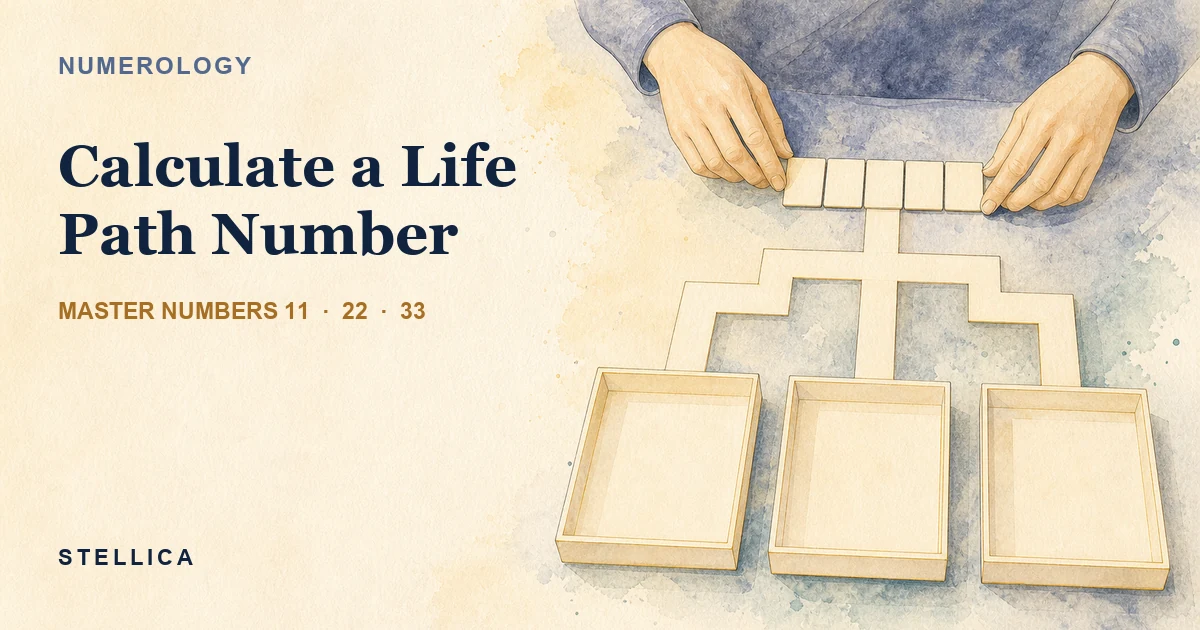
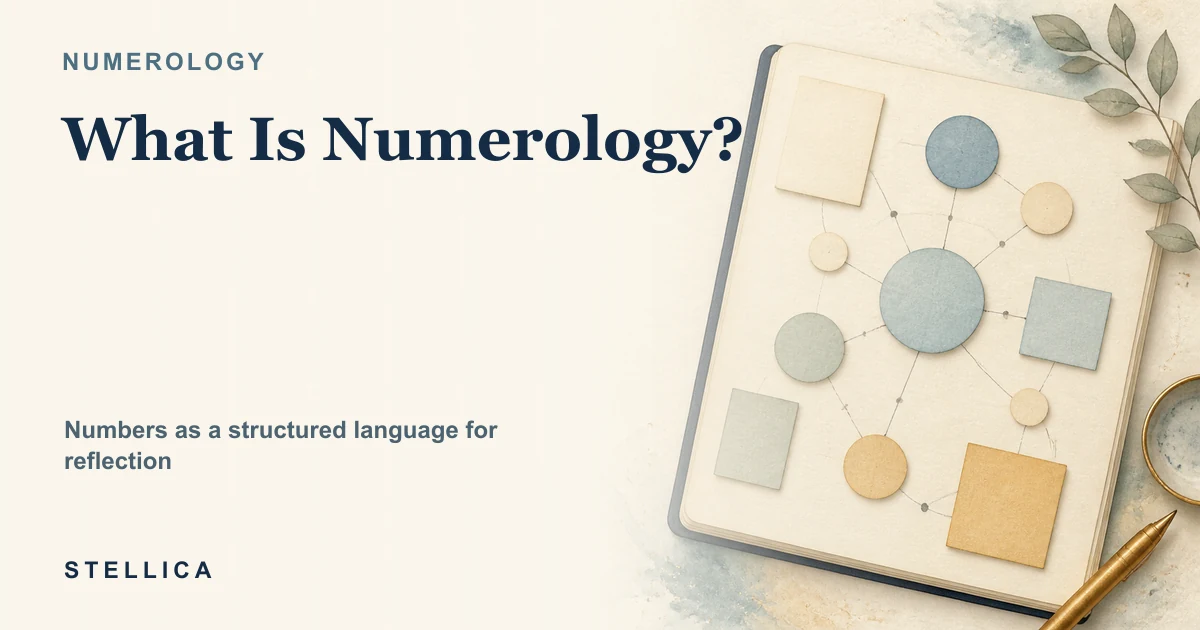
The nearby image has one job: make the input boundary visible. A date and a name can belong to the same chart, but they should not be dropped into an undefined calculation together. Each input feeds a particular position, and each position has its own interpretive question. Keeping separate trays in mind is a simple safeguard against mixing methods.
The common Pythagorean-style convention used in much English-language numerology assigns the Latin alphabet across values 1 through 9 and reads date-based totals alongside name-based totals. Calling it “Pythagorean” identifies a modern lineage or style; it does not mean the exact modern alphabet table survives as a worksheet written by Pythagoras. Historical number symbolism is much older and broader than today's personal chart format.
The map does not imply that every practitioner uses exactly the same set of positions. It shows the discipline that makes any version easier to evaluate: name the input, preserve the calculation trail, identify the position, and only then discuss meaning. If a site presents a result without those boundaries, ask for them before comparing it with another reading.
The Core Numbers and the Questions They Ask
A numerology chart can contain many positions, but five appear frequently in modern English-language introductions. Their names are not perfectly standardized. “Expression” and “Destiny,” for example, are often used for the same full-name total, while some practitioners use “Destiny” differently. Read the definition next to the label instead of assuming every site uses it identically.
| Core number | Common input | Reflective question | Important limit |
|---|---|---|---|
| Life Path | Full birth date | What broad patterns of development or approach might I examine? | It is not a schedule of inevitable events. |
| Birthday | Day of the month | What quality might be easy to notice or practice? | It does not replace the complete date calculation. |
| Expression / Destiny | Full birth name under a stated letter table | How might abilities, expression, or outward contribution be framed? | A name total does not prove talent or prescribe a job. |
| Soul Urge / Heart's Desire | Vowels in a stated name spelling | What wants or values might deserve attention? | Vowel rules and transliteration vary by system. |
| Personality | Consonants in a stated name spelling | What first impression or social presentation might I examine? | Other people's perceptions cannot be calculated as fact. |
The value of the table is not that it divides a person into five fixed compartments. It prevents scope drift. If someone asks why they do not relate to a Life Path description, it is unhelpful to quietly substitute a name number and claim the chart is accurate after all. Each position should keep its own question. Contradiction between positions can be explored, but it should not be used to make the system impossible to challenge.
Some charts add maturity numbers, personal years, pinnacles, challenges, balance numbers, address numbers, or other positions. These can be meaningful within a stated tradition, yet more positions do not automatically create more accuracy. Start with a small set, learn what each one claims to frame, and notice whether the additional layer changes a useful question or merely adds vocabulary.
For beginners, the Life Path is often the easiest entry because the input is stable and easy to audit. A name chart introduces choices about spelling, transliteration, and which name to use. Those choices are not necessarily defects, but they need to be disclosed. If you want to compare a distinctly different date-based route, read how Stellica separates Kabbalah numerology conventions rather than blending the labels into one chart.
How a Life Path Number Is Calculated
A Life Path number uses a complete date of birth and a reduction convention. Stellica's current English convention writes the date in an auditable format, adds all date digits, and keeps reducing until the current total is 1–9 or a retained 11, 22, or 33. Another practitioner may reduce the month, day, and year separately before combining them, or may preserve a different set of compound numbers.
Those methods can agree for many dates and disagree for some. Disagreement does not prove that arithmetic itself is mysterious. It usually means the grouping rule or the stopping rule changed. Record the complete trail instead of saving only the final label.
For a brief Stellica example, April 17, 1990 becomes 4 + 1 + 7 + 1 + 9 + 9 + 0 = 31, then 3 + 1 = 4. The current total never reaches 11, 22, or 33, so the reduction stops at Life Path 4. This compact trail shows the rule; it is not a second calculation tutorial.
The dedicated guide shows how to calculate a Life Path number with master numbers, including dates that make two common methods diverge. That article owns the full arithmetic. The essential point here is simpler: a repeatable result requires a declared input, one method used consistently, and a stop check applied at the same stage every time.
Do not turn an ordinary 2 into 11, a 4 into 22, or a 6 into 33 because the master-number description sounds more appealing. The calculation trail must actually reach the retained compound number under the chosen rule. The reduced base may provide interpretive context, but it does not retroactively change the output.
When you compare calculators, ask:
- Did both use the same full date?
- Did they add every digit first or reduce date parts separately?
- Which compound numbers did they retain?
- Did they check for those numbers during intermediate steps or only at the end?
- Are both results labeled as the same chart position?
These questions make numerology less opaque without claiming that one convention governs every lineage.
What the Numbers 1–9 and Master Numbers Mean
Single-digit meanings are best understood as families of themes, not miniature personality verdicts. A theme can appear constructively, become overused, remain underdeveloped, or simply fail to describe a particular person. The brief phrases below are orientation points for the cluster, not complete readings.
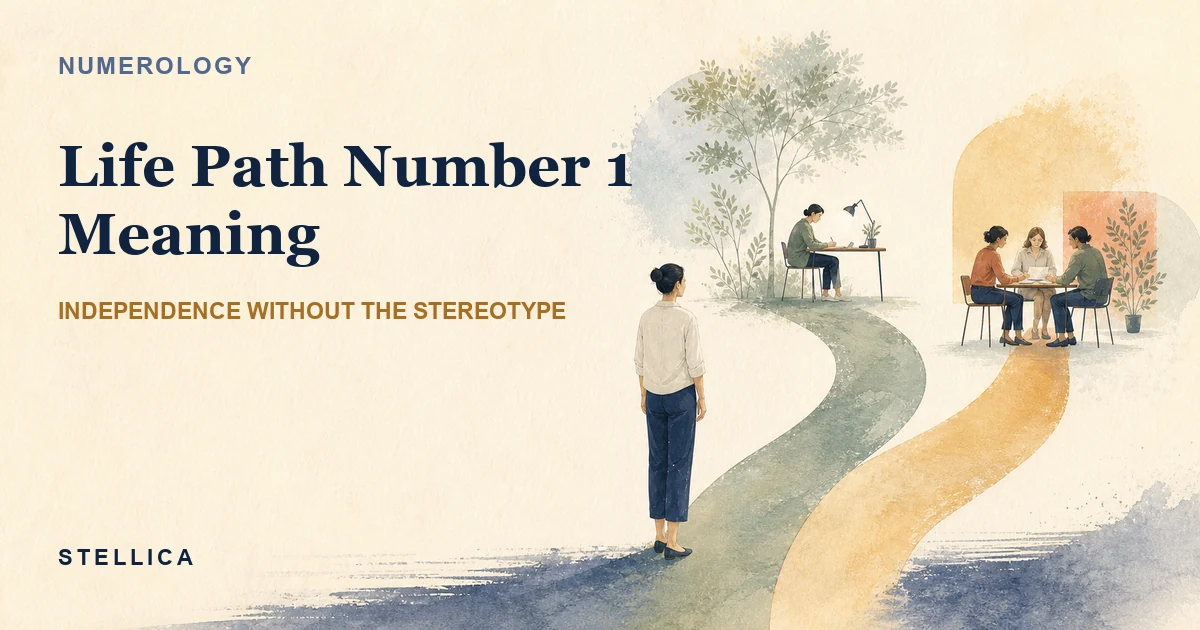
- 1 — initiative and autonomy. One can frame starting, choosing, and developing an independent point of view. Its pressure points may involve isolation, control, or abandoning the middle after an exciting start. The fuller Life Path Number 1 meaning guide treats independence without the leadership stereotype.
- 2 — cooperation and attunement. Two can frame mediation, patience, listening, and the work of making relationships reciprocal. Its pressure points may involve conflict avoidance, invisible labor, or losing a preference while preserving harmony. The planned Life Path Number 2 meaning guide focuses on sensitivity with boundaries.
- 3 — expression and creativity. Three can frame language, humor, imagination, and sharing an idea with an audience. Its pressure points may involve scattered attention, avoiding difficult feelings through performance, or generating more than it finishes.
- 4 — structure and continuity. Four can frame method, standards, maintenance, and durable effort. Its pressure points may involve rigidity, perfectionism, or protecting a familiar system after its purpose has changed.
- 5 — variety and experience. Five can frame exploration, adaptability, experimentation, and learning through movement. Its pressure points may involve escape, unmanaged risk, or leaving every loop open when novelty appears. The planned Life Path Number 5 meaning guide distinguishes purposeful change from escape.
- 6 — care and responsibility. Six can frame support, teaching, beauty, reciprocity, and contribution to a household or community. Its pressure points may involve rescuing, perfectionism, or making care into an unequal obligation.
- 7 — inquiry and depth. Seven can frame analysis, privacy, specialist knowledge, and patient investigation. Its pressure points may involve endless analysis, withdrawal without communication, or treating intuition as a substitute for evidence.
- 8 — authority and stewardship. Eight can frame execution, resources, responsibility, metrics, and ethical use of influence. Its pressure points may involve domination, work without human cost accounting, or equating worth with status or wealth. The planned Life Path Number 8 meaning guide focuses on fair and answerable use of power.
- 9 — compassion and completion. Nine can frame breadth, service, transition, release, and passing work forward. Its pressure points may involve overgiving, unclear endings, or using a universal mission to avoid personal limits.
Master numbers are compound results retained by some modern systems. Eleven is often interpreted through inspiration, sensitivity, and translating impressions into communication, with 2 as a reduced-base context; the planned Master Number 11 meaning guide gives that relationship its own boundaries. Twenty-two is often read through broad vision made practical, with 4 as a context for structure. Thirty-three is often read through teaching, care, or service, with 6 as a context for responsibility.
“Master” should not be read as a spiritual rank. A master-number result does not prove rarity, superiority, psychic ability, unusual success, or a harder and therefore more important life. It names a compound pattern within a particular convention. A grounded interpretation should be just as willing to discuss ordinary routines, limits, and contradictory evidence as elevated potential.
This loop makes room for both resonance and refusal. You can keep a useful prompt, revise an overbroad description, or drop a theme that adds no value. An interpretation earns its place by helping you observe and act more clearly, not by being worded so flexibly that every possible response counts as confirmation.

Keeping symbolic notes and lived observations on separate pages is a useful discipline. It lets the reading suggest language while protecting the facts of a situation from being rewritten to suit the symbol. Over time, the comparison may reveal a pattern, a contradiction, or simply a prompt you no longer need.
Numerology Systems, History, and Responsible Boundaries
Number symbolism has appeared in many cultures, religious texts, philosophical traditions, and divination practices. That broad history does not mean all number systems form one continuous method, nor that every modern chart convention can be traced directly to one ancient teacher. “Numerology” is a relatively modern umbrella term applied to practices with different inputs, alphabets, cosmologies, and purposes.
Pythagoras and later Pythagorean traditions are important to Western histories of number symbolism. However, the familiar modern personal chart—with a Latin-letter table cycling through 1–9, named positions, and contemporary personality language—should be described as Pythagorean-style or as part of a modern lineage. Presenting every feature as a documented invention of Pythagoras compresses centuries of development into an origin story that is easier to market than to support.
Chaldean-style numerology commonly uses a different letter mapping and may emphasize name vibrations or compound numbers differently. Kabbalistic and gematria traditions work within linguistic and religious contexts that cannot be reduced to “another version of the same alphabet chart.” Chinese number associations often draw on language, sound, and cultural symbolism rather than a Western Life Path calculation. Recurring-number or “angel number” practices interpret numbers a person notices; they are not automatically chart positions calculated from the person's date or name.
When sources disagree, identify the category of disagreement:
- Input: birth date, full name, current name, a word, an address, or a noticed sequence.
- Conversion: all date digits, separately reduced date parts, or a particular letter table.
- Stopping rule: single digits only, 11 and 22, or 11, 22, and 33 retained at specified stages.
- Position: Life Path, Expression, Soul Urge, personal cycle, or another label.
- Interpretive tradition: which themes and cultural assumptions the reader applies.
This taxonomy is more useful than asking which site is universally correct. A method can be internally consistent without becoming scientifically validated. Conversely, a symbolic practice can be meaningful to someone even when it does not establish causal or predictive power.
Numerology can support reflection, conversation, creative writing, journaling, or a check-in about how a quality is being used. It should not diagnose a mental or physical condition, determine whether a relationship is safe, guarantee financial success, replace hiring evidence, or tell someone which major life decision must be made. For high-stakes choices, use information suited to the decision: health professionals and clinical evidence for health, qualified advice for legal or financial matters, observable behavior for trust, and concrete requirements for work.
Compatibility deserves special care. Two numbers can create a prompt about pace, communication, autonomy, or responsibility. They cannot certify that two people belong together or excuse harm. The useful question is not “Are these numbers good?” but “What agreement, behavior, or repair would make this relationship more workable—and is that behavior actually present?”
Career interpretations need the same boundary. A theme such as structure may help someone name a preference for clear ownership; expression may point to a desire for feedback or communication. Neither theme measures skill, access, experience, interest, labor conditions, or economic reality. Use the vocabulary to ask better questions, then make the decision with real evidence.
A quick audit for any numerology reading
Before accepting a reading, ask five questions. What was the input? A date, birth name, current name, or noticed sequence should not be interchangeable. What rule produced the number? The calculation or letter table should be visible. What position is being interpreted? A Life Path statement cannot quietly become a claim about every part of personality. What would count as a contradiction? A reading that explains every possible response cannot be tested even informally. What action follows? Prefer a small, reversible reflection exercise over a high-stakes instruction. These questions do not decide whether the symbolism is personally meaningful; they help you see exactly where method ends and interpretation begins.
Frequently Asked Questions
Is numerology a science?
No. The arithmetic in a declared calculation can be repeatable, but repeatable addition does not scientifically validate the symbolic meanings attached to the result. Numerology is better presented as an interpretive or reflective practice. It should not be described as an evidence-based personality measurement or predictive science.
Can numerology predict my future?
Some traditions use cycles and forecasts, but a number does not establish what will happen. A cycle can be used as a planning prompt—begin, review, complete, communicate—but it cannot guarantee an event, warn of a specific danger, or replace evidence about current conditions.
What is the difference between a Life Path number and a Destiny number?
In common modern usage, a Life Path number comes from the full birth date, while a Destiny or Expression number comes from the full birth name under a stated letter table. They are different chart positions with different intended questions. Because labels vary, always read the source's definition.
How do I calculate my numerology number?
First decide which position you mean. For a Life Path number, use a complete birth date and one disclosed reduction rule. For a name number, use the specified name spelling and letter table. The step-by-step Life Path calculation guide shows Stellica's current date-based convention.
Why did two calculators give me different Life Path numbers?
They may group the date differently or retain master numbers at different stages. Compare the full arithmetic trails, not only the labels. If one tool does not show its method, its result is harder to audit.
Are angel numbers the same as numerology?
They overlap in the broad idea that numbers can carry symbolic meaning, but they are not the same procedure. A Life Path or name number is calculated from a defined personal input. An angel-number reading generally begins with a sequence someone notices, such as a repeated time or number.
Do master numbers mean someone is more advanced?
No. “Master” is a conventional label for compound values retained by some systems. It does not demonstrate spiritual rank, rarity, psychic ability, or greater human worth. The associated reduced base can add context without turning ordinary single-digit results into lesser versions.
What if my numerology description does not fit me?
Check the input, method, and chart position. Then allow the description to be wrong, incomplete, or irrelevant. You can also compare one observed match with one contradiction. A responsible symbolic tool does not require you to reshape your history to protect its accuracy.
Key Takeaways and Next Steps
- Numerology combines a defined numeric procedure with symbolic interpretation; those are two different layers.
- A useful result names its input, calculation convention, chart position, and interpretive limits.
- Modern Pythagorean-style numerology draws on a longer history of number symbolism, but today's chart should not be presented as a fully documented invention of Pythagoras.
- Life Path, Expression, Soul Urge, Personality, and other positions ask different questions even when their results use the same digits.
- Different calculators may disagree because their grouping and master-number rules differ.
- Number meanings can support reflection, but they do not scientifically measure personality, predict events, guarantee compatibility, or prescribe a career.
- The best next step is small and auditable: calculate your result with the method visible, compare the theme with lived evidence, and keep only what helps you think or act more clearly.